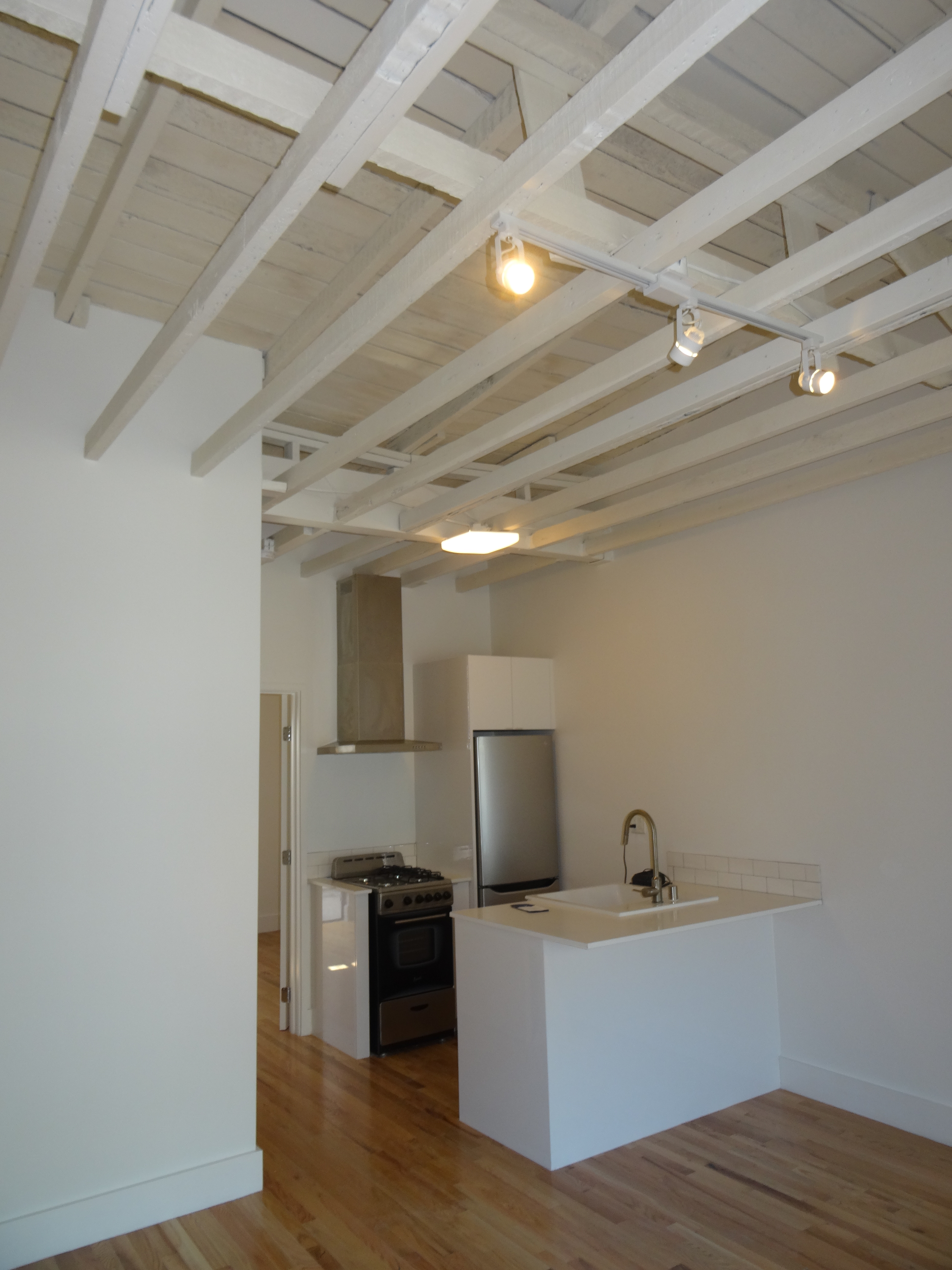
We took a 1920s low income apartment complex and removed the plaster to expose the joists and wood ceiling. With other modern features, the apartment is transformed into a creative look:
After
 Before
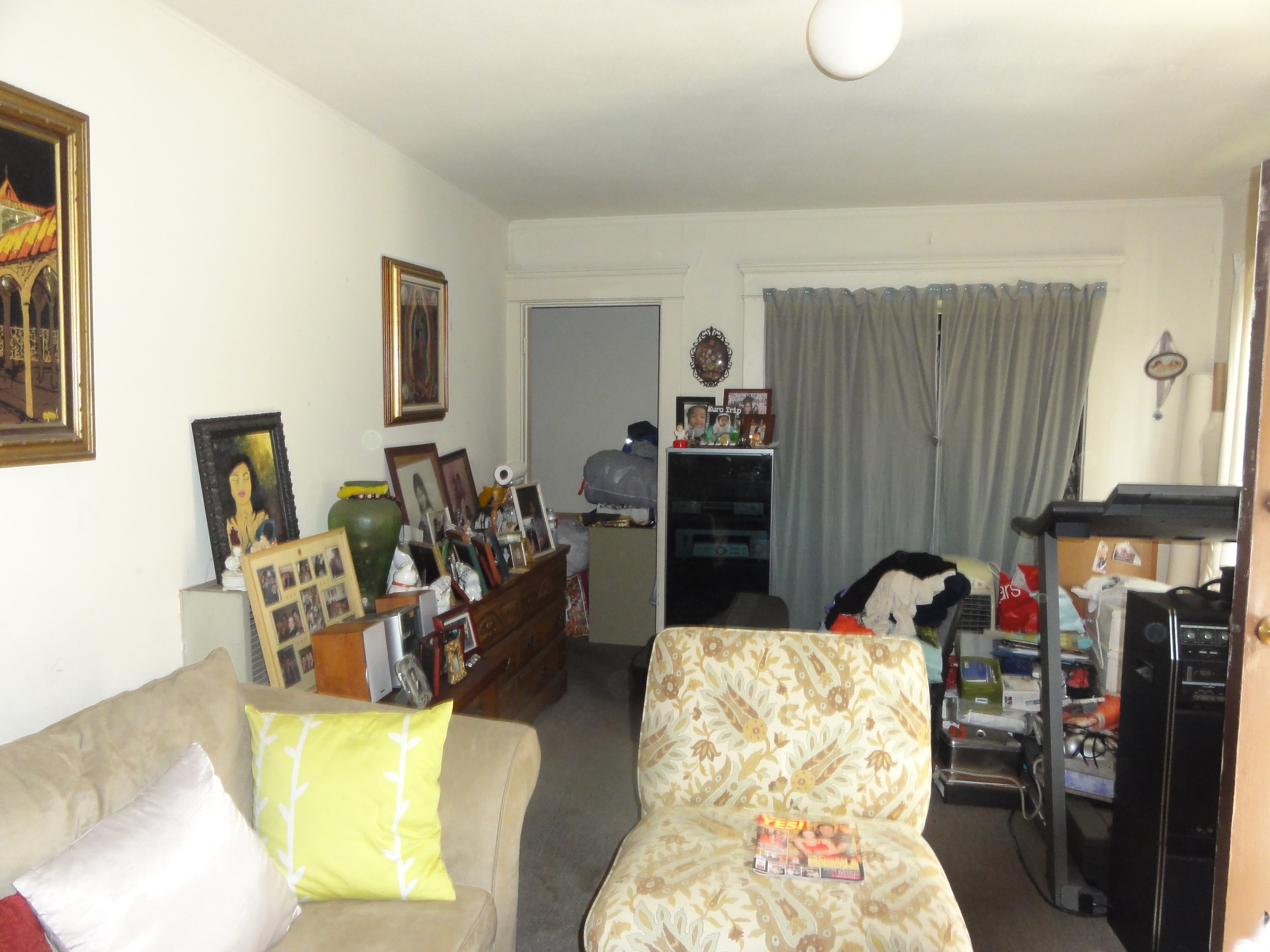
Before

We took a 1920s low income apartment complex and removed the plaster to expose the joists and wood ceiling. With other modern features, the apartment is transformed into a creative look:
After
Before
Before
The Los Angeles City Council passed the first reading of the new law requiring soft story apartments to be seismically upgraded. Soft stories are wood frame apartments, usually built between 1950 and 1978, and have open parking on the ground floor level. A structural engineer must determine if the building has a soft story. The LA Times estimated that the retrofit will cost approximately $5,000 per unit. The City Council is working on methods to help small landlords finance the retrofit but at this point, there is no such financing. The Governor just vetoed a bill that the California State Legislature passed providing a 30% tax credit for earthquake retrofit expenditures. Currently, a landlord may be permitted to raise a rent controlled tenant’s rent up to $75 per month (or 10% of the monthly rent, whichever is less) for capital improvements until they are paid. The increase is subject to review and approval by the City. It is not easily obtained. Further, tenant groups are pressuring to have the maximum rent increase limited to 50% of the retrofit cost with the maximum increase of $38 per month.
In about a month, the Los Angeles Department of Building and Safety will begin issuing courtesy letters to the owners of 13,500 wood apartment buildings warning of an upcoming order from the city to do a seismic retrofit. City officials have spent the last year canvassing the city to compile a list of quake-vulnerable apartments.
The official order letters will be sent on a rolling basis, with building officials focusing on the largest apartment buildings first.
Landlords have one year from the notice to either have an engineer provide proof that the building is not a soft story or to have an engineer complete retrofit plans. The Landlord will have an additional year to obtain a building permit. All improvements must be completed seven years from receipt of the official order. The Landlord must inform all tenants that the building is a soft story after the building is so determined to be a soft story.
If the Landlord does not comply, he shall be guilty of a misdemeanor, and shall be subject to prosecution and/or administrative enforcement under the Los Angeles Municipal Code.
Marcus and Millichap in their 3rd quarter 2015 Los Angeles apartment market report forecast 8,600 unit completions this year. Of those completions, M & M forecasts 4,400 unit completions in the Downtown area. That means over half of all new apartment units will be built in Downtown Los Angeles. Downtown is now the fastest growing residential market in LA and this trend is going to continue. Why is this happening? Billions of dollars have been invested in Downtown infrastructure and amenities including museums, parks, transits, and entertainment venues. A higher income residential cluster has formed to transform Downtown. Also, downtown is one of the easiest and most zoning friendly areas in the City to build. Developers can build density without lawsuits and homeowner fights. At some point, maybe these new residents will push back.
In the short run, at some point, this expansion may lead to overbuilding. M & M forcasts an increase in vacancy over the next few years. But in 2015, M & M is only forecasting a 10 basis point increase in vacancy to 3.7%. In the long run, this expansion will continue to transform Downtown into a popular and upscale neighborhood. This trend will also help transform many adjacent Northeast neighborhoods.
New problems are arising with our mutli-level creative office warehouse conversions in San Francisco. Originally, these buildings were built for 3 or 4 people per 1000 square feet. But, venture backed tech companies have pushed the current density to 9 and 10 people per 1000 square feet. Luckily, because of great transit, San Francisco is not suffering from parking problems created by such density in Los Angeles.
However, some of the problems we face due to the new “collaborative densities” include the following:

Squirl Restaurant Virgil Village
The Sqirl Restaurant at 720 Virgil provides a hip coffee shop restaurant experience appealing to the new millennials residents who occupy many of the newly renovated housing units in this East Hollywood neighborhood near the Sunset Junction. Previously, this area was devoid of such eateries. New hip restaurants and retail continue to fill the commercial streets adjacent the gentrifying neighborhoods in Echo Park, Silver Lake, Highland Park, and East Hollywood. Retail brokers are promoting York Avenue and Figueroa Boulevards in Highland Park as the next Abbot Kinney to drive up retail prices.
 Inside the Sqirl
This cafe replaced the La Raza Market and Restaurant. Although some in the older population resent the changes occurring to the retail in their neighborhood , the Sqirl is still one of the few such establishments on Virgil Boulevard between Melrose Avenue and Santa Monica Boulevard. Gentrification takes decades and occurs in fits and starts. Currently, many homes have been renovated to appeal to younger home buyers and now many apartments are also being renovated.
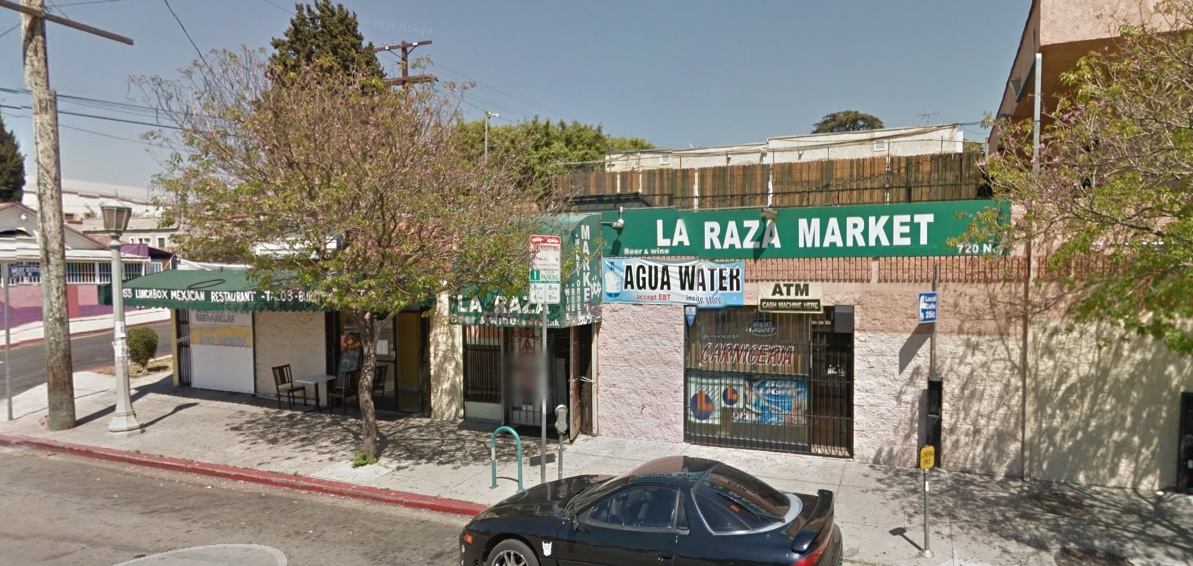
Formerly La Raza Market and Restaurant

Cain Hoy Enterprises, a Greenwich, Connecticut private investment firm, shelled out $130 million for the 118,400 square-foot Class A office building at 100 N. Crescent Drive. This price equals a whopping $1,101 per square foot. The seller, New York’s Clarion Partners, purchased the building in 2012 from another private equity firm, Clarity Partners for $80 million, a 63 percent return in three years.
In April of 2000, Clarity Partners purchased the building from JP Morgan for a measly $37 million or $313 per square foot. Most forget that real estate values flat lined during the dot com boom. Everyone wanted to buy internet stocks, not real estate.
JP Morgan, in turn, purchased the property in October 1995 from the original developer: Tracinda Corporation. Now deceased billionaire Kirk Kerkorian owned Tracinda Corp and built the building in 1990 for his corporate headquarters at a cost of around $400 per square foot. The selling price in 1995 was $21.6 Million or $183 per square foot Unfortunately, office prices plummeted during the early 1990 recession.
Prime Beverly Hills properties continue to appreciate, just not always in a straight line.
Source: Beverly Hills Office Trades at Premium Price | Los Angeles Business Journal
Eventually imbalances and overvaluations give rise to corrections we call recessions. Last weeks, the overvaluations and imbalances in the Chinese stock market and economy started to correct and gave rise to over a 10% decline in the SP 500. Such declines do not always give rise to recessions and do not foreshadow future economic peril. For example, in the third quarter of 2011, although the S&P 500 declined over 12%, the economic recovery continued to proceed for four additional years. Many large stock market declines over multiple quarters occur just before or during the early stages of the recession. These losses are large and reflect the current deteriorating state of affairs.
Smaller stock market hiccups have presaged recessions by one to two years and reflect cracks and strains in the economy. Such hiccups have occurred in 1978 (Oil Shock), Oct 1987, 1998 (Russian Financial Crisis). The cracks and strains in major economic pillars presage economic troubles, not the stock market declines. Indeed, there was no stock market hiccup that proceeded by one or two years the 2008 recession. By the time the stock market dived, the recession soon followed. However, the housing market had already started to crack in some parts of the country as early as 2006 and the subprime market soon followed.
Last week’s events showed strains in the Chinese economy and its impact on domestic prosperity. Despite these strains, the economy can keep chugging up, but other strains and imbalances will continue to grow. No other domestic indicators show any problems, and short term interest rates are still zero. The yield curve is still very positive. Perhaps, these recent strains signal that we are in a latter but not final inning of this cycle.
Gentrifying neighborhoods are seeing the influx of new companies and residents as developers create new offices and apartments in the Art District in Downtown Los Angeles, Hollywood, Mid Market San Francisco, and the Mission District in San Francisco. Rents are rising rapidly in those neighborhoods. Many of the existing residents in these areas are protected by rent control. On the contrary, those that are not protected are seeing their rents spike.
At the same time, these gentrifying areas are also seeing an increase in the homeless population. This is a result of a combination of early release from prisons, rising rents, stagnant wages, warm weather, and new construction disrupting former homeless hangouts. Locals and activists are calling for more aid, rent control, and less enforcement of homeless encampment laws. Both activists and the real estate community agree that part of the solution is developing more affordable housing.
New residents and workers are encountering more homeless encampments. The solution remains elusive. Even in Venice, a mature neighborhood way down the gentrification road– where homes sell for over $1,000 per square foot– struggles for answers to this social issue.
The article below discusses the clash of new technology companies with lower income and homeless residents in the mid market neighborhood of San Francisco.
Blending Tech Workers and Locals in San Francisco’s Troubled Mid-Market – The New York Times.
Los Angeles is ranked #3 as the leading City for startups. Compass and Techcrunch ranking gauges the world’s leading startup ecosystems—the broad infrastructure of talent, knowledge, entrepreneurs, venture capital, and companies that make up a startup community. The report measures these ecosystems based on their quality of talent, pool of venture capital resources, experience and mentorship provided by startup founders, market reach of their companies, and the ultimate performance and exit value of their companies. Increasingly, the global economy will be defined by the startups and entrepreneurs that are making tomorrow’s technologies a reality, according to Bjoern Lasse Herrmann, the chief executive at Compass. Herrmann believes a nation’s strength will continue to rest on the shoulders of hundreds of innovative small businesses. Herrmann says: “As the Industrial Economy falls away with increasing speed and half the world’s current jobs will be replaced by software, it becomes critical to build thoughtful programs to nurture the entrepreneurial renaissance that will take its place.”
Los Angeles will gain economic traction as it continues to produce new business.
The World’s Leading Cities for Startups and Innovation – CityLab.

Moderators at every real estate conference ask their speakers to comment on what inning of the cycle they believe we are in. Howard Marks of Oaktree Capital says we cannot predict the timing of the cycle– we can only recognize where we are now. Unfortunately, we cannot predict the length of the latter stage. It is during this stage that excesses are produced and expanded upon. Up it goes until it blows.
Over the last 30 years, I’ve been able to identify certain events, signs and trends that have occurred at the latter stages of some cycles. Not every one of these indicators have appeared during all the maturing cycles.
1. Prices and rents soar substantially above their previous peak. The new records are discussed at parties, conference, and dinner conversations and described as “crazy.”
2. Property prices and construction costs are climbing but developers/investors count on rising rents or prices to make their projection. Worse yet, developers trend up their projected rents or prices.
3. A form of very high leverage debt enters the market shifting the risk from equity to credit and increasing equity yields. Worse yet, the debt is non-recourse.
4. There is noticeable jealousy between the guys doing deals or selling properties and making significant amounts of money. Some developers and investors are achieving spectacular results.
5. The Fed is raising interest rates.
6. New construction reaches very high historical levels in some real estate markets and/or real estate property types.
7. Mortgages are easy to get, and there is a lot of competition among lenders.
8. Some lenders start to lend more on appraised value and are less restrained by cost on recently acquired deals or new construction.
9. Politicians and activists become more focused on the problems of growth and inequality than on the creation of jobs.
10. Architects are very busy, and it is hard to get things through the City.
11. The high prices and high levels of new construction are justified by supply and demand projections and changes in society and demographics making this time different. Some justify the prices paid or low expected yields by reference to the long term.
12. Few are predicting an imminent recession.
13. Good acquisition people are in short supply and being paid increasing amounts of money.
There could still be remaining runway, even after these signs appear. For example, the latter stages of the last housing boom in Los Angeles lasted from 2005 through mid 2008. It is just a risk call. Indeed, the latter innings are usually the most glorious of all, and one can make a lot of money if they play it right– or crash. For the risk averse, when the signs appear, it may be time to leave the casino and enjoy the floor show.

