Unknown's avatar

About PMI Properties

PMI is a thirty year old property investment company located in Beverly Hills/Bel Air that invests in commercial and residential real estate. Since its founding in 1978, PMI Properties has closed over $500 million in office, shopping center, industry and apartment properties throughout Los Angeles and San Francisco. PMI's most recent endeavors have focused on pioneering creative office suites in office buildings and converted warehouses.These properties have been primarily located in Los Angeles and recently in San Francisco. PMI had its roots in investing in apartments, but more recent investments have focused towards offices, creative offices and converted warehouses. PMI was the first to pioneer a new, creative suite in office buildings with its proprietary "lifestyle suites," which featured skylights, partial hardwood floors, designer lighting, raised ceilings, interior glass, and other upgrade features. PMI pre-built the suites in an efficient and generic floor plan that not only achieved a premium, but also rented faster than suites requiring build-to-suit modifications. PMI was also one of the first to convert warehouse industrial facilities into flex creative space prior to the Internet boom. Today, PMI's suites are some of the most coveted creative offices on the market. Subscribe to get our newsletter and blogs for free! http://eepurl.com/hG0V2

Using Lyft to Solve the Los Angeles Office Building Parking Problem

A Lyft Driver's Car

A Lyft Driver’s Car

Los Angeles companies continue to densify and fit more employees into less space.  The problem is where to park these employees.  Planners are betting the farm on new forms of public transit to solve this problem  Even with public transit, the problem is how to get from the train or light rail station to the office.  There is still a lot of street parking in Los Angeles as well as under-utilized lots.  However, this  parking is not within acceptable walking distance.  In Los Angeles, if you cannot open your car door and fall into the front door, it is not an acceptable walk. To solve the problem, about 20 years ago, the cities mandated mandatory ride sharing programs.  Companies complained of the expense, and the rideshare legislation was rescinded.

Now social media and collaboration has produced another form of private ride sharing in companies like Lyft and Uber.   Lyft is  an iphone or adroid app you use to summon a driver and pay him a suggested donation.  I have been told that in Los Angeles, these donations can be less than two thirds of the price of a cab ride. You can see the available Lyfts near you on your smartphone and whether they are coming to get you.

Companies or landlords could contract with Lyft drivers to pick employees up from the Expo station or other areas with available parking and take the employees to work.  This process may end up being less expensive them hiring a valet or building additional parking spaces.  At $10 a day for rides back and forth to work from a nearby location–the Lyft would cost $200 per month.  OK, that is more expensive than most parking lots but not prohibitive.  Throw in some car pooling, and the price goes down.

Another alternative is for companies to do their own Lyft.  Designate those with parking as the drivers and the others as the passengers.  The passengers can send an alert out and a nearby driver can respond for a pickup on the way to the office. If no driver is available, the office can send out a designated driver for pickup.  Phone apps like instant messaging or Find My Friends or GPS Tracking can be used to facilitate pickup and logistics.

Can Fitbit Help the Office Parking Problem?

Fitbit

Fitbit

The Fibit is one of many social media wearable smart pedometers in the market today.  The Fitbit (like the Nike Fuelband and the Jawbone Up) tracks your steps, calories, miles, and aerobics.  You can share your results with friends also using the device and create a competitive environment.  Walking can burn calories.  You get almost  as much calorie burn per mile whether you run or walk, although you will  not get the same cardio benefits in a walk.  The Fitbit or these other devises try to get you addicted to walking.  The goal is at least 10,000 steps a day.  If you subtract 3,000 steps you would get anyway in daily living, you achieve about 7,000 extra steps.  That can equate to a little over 3 miles per day (equivalent to a half hour or more run for many).

Our office building at 10951 Pico Boulevard is a third of a mile from plentiful free  parking along the new Expo Line.  We can give employees who give up parking a Fitbit if they use the Expo Line parking.  Each day, the employees would get 1385 fit bit points (steps)  for a seven minute walk to and from work toward their 10,000 steps.  Thus, both the exercise and parking problems are solved.

How Will Older Office Buildings Compete in the New Workplace? Did Someone Give an Office Recovery and Forget to Invite Us ?

Many buildings  will be at a competitive disadvantage because of their design. Further, changing office density (workers per square foot) is becoming a heavy drag on a stronger recovery in the office market.  Business are finding ways to fit more people into less space.  This is not your father’s recovery.  Companies are shrinking their per-employee square foot requirements while demanding more collaborative space. Even as tech and media companies hire, other companies continue to shed employees.   The net result is a slower office recovery than in previous cycles.  We have seen this manifest in continued high tenant improvements and free rent even in strong markets like the Santa Monica.  Business are demanding and getting the latest and greatest tenant improvements.  With vacancies still over 10% in most markets, Landlords are forced to comply or they comply to maximize contract rents.

In today’s Los Angeles Times (October 13), one broker explains:

One big reason this office market recovery is much slower than others is that many firms are packing more workers into less space.

The ho-hum recovery has hit downtown Los Angeles especially hard, said broker David Kutzer of Newmark Grubb Knight Frank. Law firms, banks and other corporate businesses have been cutting back on private offices and workers’ cube space. Open floor plans are becoming the norm.

“There is far less ‘me’ space and more ‘we’ space,” Kutzer said.

See:  Los Angeles Office Market’s Ho Hum Recovery

In Los Angeles and San Francisco, the market is driven by tech and/or media tenants who desire creative spaces.  These tenants want more power, flexible lease terms, open and high ceilings, less offices, more conference rooms, bigger kitchens, and non-corridor entries.   The new density is creating a special problem for Los Angeles office buildings.  Businesses now need parking that most buildings do not have.  Businesses now need more than 3 spaces per 1000 square feet as their density skyrockets above 4 employees per 1000. The success of Hackman’s Hayden Place and the Reserve and Hercules campuses  in Playa Vista can be attributable to their creative design and plentiful parking.

You can read the full article below.

How Will Older Office Buildings Compete in the New Workplace? – CoStar Group.

PMI SELLS TWO ICONIC SOMA SAN FRANCISCO CREATIVE OFFICES

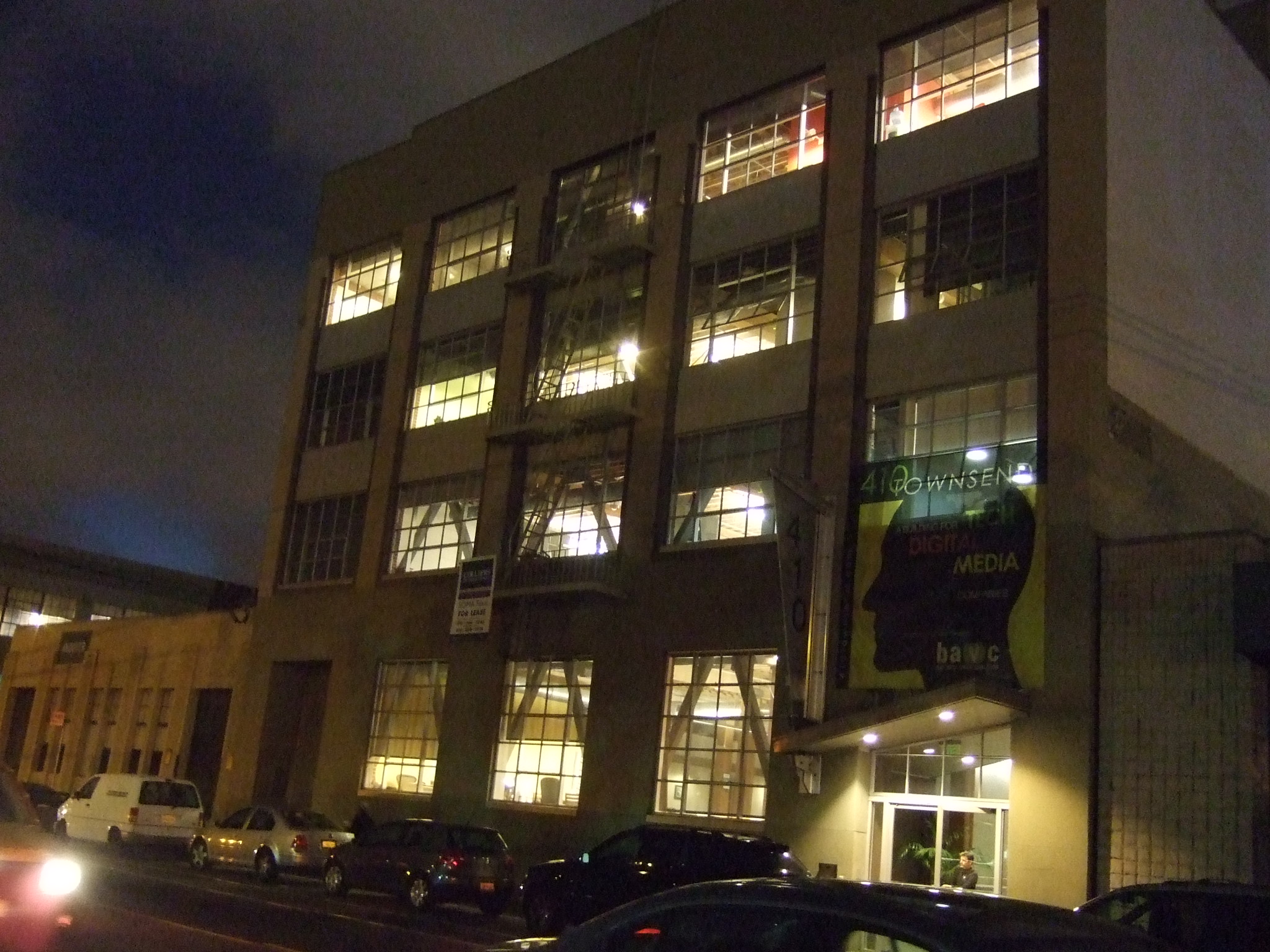
410 Townsend

410 Townsend

539 Bryant

539 Bryant

PMI Properties is pleased to announce the sale of two iconic South of Market San Francisco creative office buildings: the 75,000 square foot 410 Townsend Street and the 55,000 square foot 539 Bryant Street. The buyers were affiliates of Zurich Alternative Asset Management.  The purchase price matched or exceeded those obtained by class A trophy conventional high rise office buildings.  The sale dramatizes the new demand and popularity of warehouses converted into creative offices in key media and technology markets.

PMI Properties purchased the properties in the mid 2000s during the recovery of web based software companies.  They made the bold move of branding the buildings for web start-ups by introducing the first collaborative office designs, utilizing a flexible leasing policy, and leasing exclusively to web start-ups.  This strategy was enacted to create a cluster effect and effectively brand the building as the center of tech start-up activity.  The successful strategy was featured in the Wall Street Journal in 2010.

In it’s start-up phase, Twitter moved into a 4,000 square foot office at 539 Bryant after their first round of venture capital funding.  Other successful start-ups at these two buildings include Yammer (sold to Microsoft for $1 billion dollars), Playdom (sold to Disney for $763 million), Tech Crunch (sold to AOL), Guardian Edge (sold to Symantec),  Aperture (sold to Google), Ioda (sold to Sony), Coding Technologies (sold to Dolby), Xobni (sold to Yahoo!), Eventbrite, OpenDNS, Scribd, Zendesk, Jaspersoft, Ustream and Yousendit (now known as Hightail).

Recently, Adobe leased most of 410 Townsend for ten years and HKS Architects leased the ground floor of 539 Bryant for ten years.  Coincidentally, Adobe bought the start-up Macromedia who started at 410 Townsend in the 1980s.

SaMo Approves Big Plans for the Bergamot Station Area

Santa Monica passed a sweeping rezoning of the Bergamont Station Area, which encompasses most of the LSMD (from Bergamont to Colorado Avenue).  Most of the area is being up-zoned into a new zoning called Mixed Use Creative.  Mixed Use Creative will allow greater densities as well as office, retail, multifamily, and creative office.  The City has not yet provided a definition of creative office. A small area near Berkeley and Stanford will be preserved for low density creative office only.  The City is requiring the first 40 feet of Nebraska Avenue frontage to be used for small retail.  They envision Nebraska south of Stewart to turn into a walking street loaded with outdoor cafes.  Oh Vey.

Parking requirements will be lowered to 2 cars per 1000. For the first time in LA County, the City is imposing a parking maximum of 4 cars per 1000 that will drop to a maximum of 2 cars per 1000 as the area is developed. The parking requirements are among the lowest in the Los Angeles County.  Curb LA first reported this sweeping zoning legislation.  The article below has a great pictorial of the new zoning (click on the pictures).

SaMo Approves Big Plans for the Bergamot Station Area – PlanningWatch – Curbed LA.

Culver City attempts to increase parking in the Hayden Tract while Santa Monica reduces parking requirements in the old LSMD

The Culver City Planning Commission last Wednesday voted for a plan to encourage additional and alternative parking in the Hayden and Blackwelder Tract.  Under the new plan, a parking district would be created whereby owners could lease offsite parking anywhere in the district to satisfy parking requirements.  Further, parking requirements could be satisfied by mechanical parking, valet parking, or compact parking.

Meanwhile, the Santa Monica City Council  approved a plan for the Bergamont Transit Area (the old LSMD near Bergamont Station)  that reduces  required parking for office to 2 cars per 1000 square feet but also limits properties to a maximum of four cars per 1000 square feet.  As more parking spaces are built in the area, the maximum amount of parking that a property can have will be 2 spaces per 1000 square feet.