Homebuilders and buyers rush back in to Bay Area’s exurbs – San Francisco Business Times

It was the Economy Stupid. During the recession, many pundits pronounced the exurbs dead and likely to become ghost towns filled with obsolete McMansions.   Everyone was downsizing and moving back to the City center.  Not so fast.  In one of the first economies to boom since the recession, housing in the San Francisco Bay Area exurbs are making a comeback driven by commuters looking again for affordable single family homes.  Read this article below:

Homebuilders and buyers rush back in to Bay Area’s exurbs – San Francisco Business Times.


A Rebuttal to David Stockman’s “This Is Housing Bubble 2.0”

Ronald Regan’s former budget director, David Stockman, declares the recent turnaround in the housing market as bubble 2.0.  He cites as an example markets like Phoenix where prices have risen 20% .  I disagree and see this as a bounce off the bottom where prices got so cheap that there was finally a recovery.  Investors saw they could achieve a better yield buying and renting homes than they could on other assets including apartment buildings.  In Phoenix where prices had fallen 70%, prices would have to rise over 300% to get back to the peak. A 20% increase, after a 70% fall, is far from a bubble.  Phoenix housing prices are only at pre-housing boom 2002 levels, according to Zillow.   The housing bubble was caused by lenders giving a 100% financing to first time buyers who speculated on prices increasing.   Now it is difficult to get loans except for the most credit worthy, and substantial down payments are required. Today’s first time home buyers are the most credit worthy and find the economics and lifestyle benefits just too compelling  to rent.   As the economy recovers, households are forming, but many are moving into rental housing.

The most fundamental sign of a bubble is a disparity between the cost of owning versus   renting. The greater the cost of owning versus renting, the greater the bubble.   During the bubble, the disparity was at its largest in recent history.  Now it is either normal or unusually low.

The current recovery may not be a boom but it is not a bubble.   Yes historically low interest rates are pushing up all asset values, but at least with housing in certain areas, values are far below peak and their long run statistical trend.  You can read David Stockman’s arguments in the article below.

This Is Housing Bubble 2.0: David Stockman | Daily Ticker – Yahoo! Finance.

“Mr. Gorbachev Tear Down This Upper Cabinet”

Creative multifamily renovators are removing the separation between the kitchen and the living/dining room in older apartment units to give them a contemporary layout.  In many apartment kitchens, an upper cabinet separates the kitchen from the dining/living room and leaves only a pass-thru.  The removal of this upper cabinet not only unites the room but allows for the creation of an eating bar creating a “cafe kitchen” look.

Upper Cabinet Separation

Upper Cabinet Separation

Cabinet Separation Removed

Cabinet Separation Removed

Architectural Features of Hipster Design in Northeast Los Angeles

The article discusses the design features used by flippers who sell to hipsters in Northeast Los Angeles

“I wanna inject a little bit of youthfulness,” says Jones, “a little bit of modern into it, so what I’m looking for are these sort of modern elements juxtaposed with this vintage thing, a modern-vintage hybrid.”

Why I’m Fine With the ‘Hipster Flip’ Phenomenon – Los Angeles – Arts – Public Spectacle.

Handles are in and knobs are out in new apartment kitchens

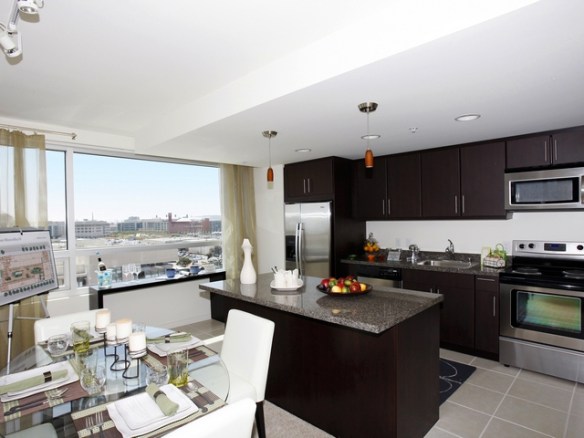
I have noticed more use of wide handles on kitchen cabinets and less use of knobs.  In Bravo’s new reality show, Start-ups: Silicon Valley, young attractive start up hopeful Kim Taylor shows off her kitchen in her Mission Bay apartment at the Avalon.  The apartment is typical of most new apartments:  espresso cabinets with long silver brushed handles, open to living space, granite or Cesar stone counters, stainless steel appliances, and an eating bar:

avalon kitchen kim apartment

Gentrification of Rose Avenue in Venice

PMI has a creative office building on Rose near Main Street and the new Google offices.  The property was always a performer for us because of its proximity to the popular Main Street in Santa Monica on its north, Abbot Kinney in Venice on its south, and Venice Beach on its west.  If you went a few blocks East on Rose Avenue, the area become seedy with homeless, crime, and run down retail.  In the last six years, this area has transformed and gentrified into a new hip location.  The Los Angeles Times article describes this transformation.

Venice’s new bloom – Los Angeles Times.

Urban Land Institute Study on How El Segundo Can Compete with Santa Monica for Creative Tenants

The Urban Land Institute has just completed a study on ways to compete with Santa Monica and Venice to attract creative office users.

PARKING

CONVERT WAREHOUSES TO CREATIVE SPACE

FIBER OPTICS

For Culver City–work on parking, parking, parking and make it easy for developers to convert the warehouses to creative office (which means helping figuring out the parking).  Culver City has a good inventory of mid century warehouses buildings which developers have converted into amazing creative space.  Samitaur has supplied ground breaking architecture.  That has been one of Culver City’s magnets.

El Segundo Sees Creative Ways to Lure Business

By Jacquelyn RyanMonday, July 30, 2012

Move over, Silicon Beach: El Segundo wants in on the tech boom action.

The Urban Land Institute just completed a study for the city that suggests ways it can develop its own creative office space hub that would compete with Santa Monica and Venice, where Google Inc. occupies more than 100,000 square feet and is looking for more space.

The focus of the plan is the former industrial neighborhood known as Smoky Hollow, bounded by the Chevron oil refinery, Pacific Coast Highway and El Segundo’s downtown corridor.

Urban Land Institute consultants conducted the study to help the city identify amenities and services it needs to provide to attract creative firms and become an incubator area for startups. The study, released last week, found that the neighborhood’s industrial feel, small midcentury buildings and beachside locale will be attractive to such firms. Building prices are also advantageous, coming in at least $325 a square foot cheaper than Santa Monica.

But to be truly competitive, the city needs to increase its fiberoptic connections, add parking and amend its specific plan to encourage adaptive reuse, because creative companies seem to be attracted to a concrete-floor, bare-ceiling aesthetic.

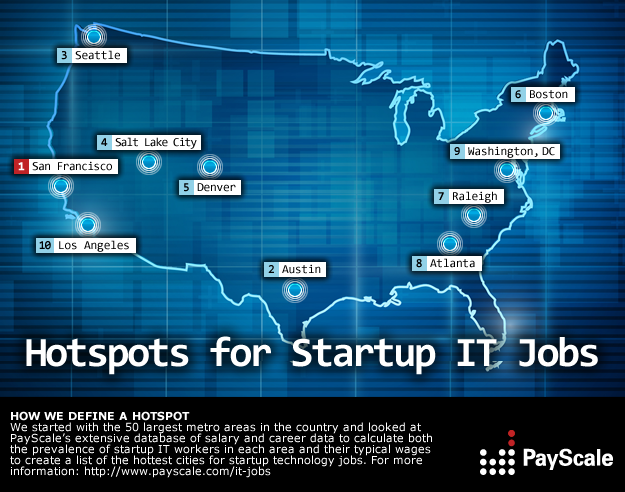
Map: The hottest spots in the U.S. for startup tech jobs – GeekWire–Los Angeles Continues to Lag.

hitechhotspots_image03

This article below from last year shows Los Angeles as low as number 10 as a hotspot for tech startups.  This contrasts with the dot com boom where Los Angeles was a solid four.  A lot depends on how one slices and dices data.  When you look at Los Angeles Orange County as a region, it ranks number 3 to 5 in venture funding ( depending on the quarter) according to Money Tree Price Waterhouse.  However, the rank falls perciptiously when you look at just  software venture funding as this area is driving the urban tech boom.  A recent article by Richard Florida put Los Angeles.  An article by Richard Florida, published in the Atlantic Cities (June 13, 2013), America’s Leading Metros for Venture Capital, shows the Los Angeles Metropolitan Area as number 5.

Map: The hottest spots in the U.S. for startup tech jobs – GeekWire.