RADICAL RENT CONTROL IS AGAIN ON THE BALLOT

The new measure again allows the expansion of rent control to owners of more than one single family home, corporate owners, and owners of apartment buildings over 15 years old. Further, rent increases on vacant units will be severely limited. This measure will cause a radical decrease in property values , discourage new construction and property renovation, create a shortage of available apartments, and raise the rents on non-controlled units.

This time though, the proposition will be more difficult to defeat. First, the new proposition has exempted most single family homes. Second, the voter turnout will be greater and more liberal. Third, rents have continued to increase.

On the positive side, CAA (California Apartment Associated) supported AB1482 which instituted a more moderate rent control statewide. We believe AB1482 will mute support among some for this new version of the 2018 Prop 10 radical rent control ballot measure. Also AB1482 should end the horrible headlines of tenant rents doubling or tripling overnight.

However, it is critical that all owners contribute to the campaign to defeat this new proposition. Don’t assume you can free ride off of large landlords. Blackstone has sold out their interest in single family homes.

The pro-radical rent control advocates will try to market radical rent control as a solution to the homeless crisis, which has arisen to the number one issue amongst Californians. Here are summaries of the upcoming 15 second pro-radical rent control commercials:

• ‘The Squeeze’ – a single take, slow motion close-up of a hand tightly squeezing an orange dry as a narrator V.O. says: “Corporate landlords are squeezing California renters dry. Seniors, veterans and working-class families are being priced out of their homes and neighborhoods and forced to sleep in cars and on our streets. Join the movement and stop the squeeze…”

• ‘Apocalypse’ – Several stark black & white tracking and drone shots of tents and the homeless on Skid Row in Downtown Los Angeles with a voice over narration: “The apocalypse is now. How did homelessness get so bad? How much worse can it get? Rising rents are driving thousands onto the streets. California needs to expand rent control. Tell your elected officials, we need rent control now…”
Owners need to get their side of the story out to the public. Contribute to the organization set up by the California Apartment Association to fund the opposition. Please send or wire your contributions to Californians For Responsible Housing, who is recommending a contribution of $10 per unit:

Please make all checks payable to: Californians for Responsible Housing – 2020

Mail checks to: Nielsen, Merksamer, Parrinello, Gross & Leoni, LLP, c/o Elli Abdoli
2350 Kerner Blvd., Suite 250, San Rafael, CA 94901
Los Angeles Councilmember Seeks to Eliminate 3% Floor for Los Angeles Rent Control Apartments and replace it with 60% of CPI

Los Angeles Councilmember Seeks to Eliminate 3% Floor in RSO
Call City Council Today and Tell Them You Oppose!
City of Los Angeles Councilmember Mike Bonin is proposing to eliminate the 3% floor that has been the backbone of the City’s’ Rent Stabilization Ordinance since 1978. His proposal calls for the elimination of the 3% floor to be replaced with a new calculation – 60% of CPI. This is part of a broader package of proposals related to housing.

The current allowable increase calculation was the result of compromise at the inception of the rent control program. The 3% floor has long existed as a safety mechanism for housing providers. It ensures they do not fall victim to costs that rise independent of the Consumer Price Index (CPI).

The CPI is a consumer index. It does not take into account rising operational expenses such as real estate taxes, insurance, the city’s gross receipt tax, utilities, water, sewer, waste franchise increases, pest control, repairs and maintenance, earthquake retro-fitting, painting, cleaning, landscaping, vacancies, management administration, advertising, legal costs and a whole host of other expenses incurred through operating rental housing. These costs are increasing significantly in the City of Los Angeles.

All housing providers must reach out to the council members. Tell them you oppose any changes to the allowable increase formula in RSO buildings. Let them know how it will negatively affect your ability to provide housing in the City.
Contact the City Council Today!

Fed’s Rosengren flags risks to economy in WeWork-style model

Sept 20 (Reuters) – The rise in co-working spaces like those offered by WeWork may be a source of financial instability that could make the next U.S. recession worse by sparking a run on commercial real estate, Boston Federal Reserve Bank President Eric Rosengren said on Friday.

“I am concerned that commercial real estate losses will be larger in the next downturn because of this growing feature of the real estate market, which could ultimately make runs and vacancies more likely due to this new leasing model,” Rosengren said prepared remarks that also explained why he dissented against the central bank’s decision earlier this week to lower borrowing costs for a second time this year.

Office-space sharing companies often use special purpose entities to lease space, in order to shield themselves in case of bankruptcy, he said. That puts more potential stress on the property owners themselves in case of a downturn. But shared office space often pays higher rent than other types of commercial offices, making it an attractive option for property owners trying to squeeze more yield out of their assets in a low-interest-rate environment, Rosengren said.

“It will not be until a recession that this evolving model will be truly tested,” he said.

Rosengren did not mention WeWork or any other company by name. But while commercial real estate valuations and lending standards have for Rosengren been a persistent worry, it is the first time he, or any Fed policymaker, has publicly focused specifically on risks from the rise of such flexible workspaces to the overall U.S. economy.

Wework’s swelling lease obligations, and the potential risk to revenues if tenants vacate during a downturn, have been one of several issues that have soured investors against the company’s initial public offering.

WeWork owner The We Company this week postponed its initial public offering of stock planned after weak demand for its shares forced it to dramatically discount its expected IPO value to between $10 billion and $12 billion, down from the $47 billion valuation it achieved in January.

“The fact that the shared office model relies on small-company tenants with short-term leases, combined with the potential lack of recourse for the property owner, is potentially problematic in a recession,” Rosengren said.

“Its important to think about the potential for runs on commercial real estate stemming from a situation where short-term leases might not be renewed in recession, and long-term leases are no longer economically viable.” (Reporting by Ann Saphir Editing by Chizu Nomiyama)

A Wave of New Apartment Construction Can Lower Rents

A wave of new construction is lowering apartment rents in Sydney Australia

Source: Heads Up, California: Sydney Has Figured Out How to Get the Rents Down – Reason.com

A supply glut also lowered rents in Los Angeles in the late 80s.  Combined with the recession in the early 90s, the oversupply kept kept rents down for almost a decade.  Los Angeles developers never produced the multifamily unit count achieved in the 80s.  A few years of 20,000 plus apartment deliveries would lower rents.


What It Is Like to Find a Rent Stabalized Apartment Without Vacancy Decontrol

Here is what it was like when New York allowed voluntarily vacated apartment rents to be increased by only 20% plus an allowance for renovation costs:

“At Thursday’s hearing, tenants described devoting hundreds of hours to finding apartments for their families only to be stymied by excessive upfront costs. In one example on the extreme end of the spectrum, a tenant who was renting a Manhattan apartment for $2,650/month who decided to go through with the lease said they paid $12,570 in fees before moving in—including a $4,770 brokers’ fee, a security deposit equal to one month’s rent, and a litany of other processing and application fees.”

Soon it will be virtually impossible to find a rent stabilized apartment in New York after the legislature revoked the landlord’s ability to raise rents when a tenant moves. In Los Angeles, you can find plenty of one bedrooms and even two bedroom rent stabilized apartments (and in some areas 3 bedrooms) for $2,650 by just looking in Craiglist, Zillow or any many other websites and Landlords compete for the tenant’s business.

Appfolio Snags 4,999 sq ft Lease at Rose Studio

Outside View

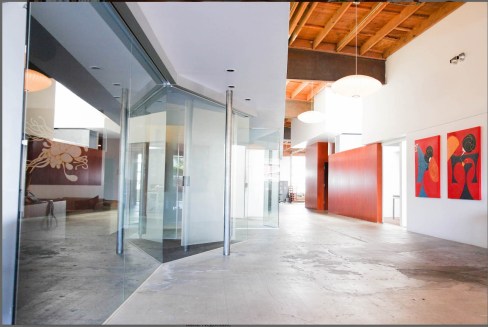
PMI is proud to announce that Appfolio, the apartment management accounting software company, is filling the 4,999 sq ft space located at 215 Rose Avenue in Venice. Their offices are located next to Mail on Line and House Brewing and across the street from Google’s Venice offices. David Wilson and James Wilson of Lee & Associates WLA represented the landlord and Greg Lovett of Cresa represented Appfolio for the five year lease.

Appfolio is software designed for property managers who want to automate, modernize, and grow their business. Founded in 2006, Appfolio has grown rapidly to become an all in one solution to manage multiple property types including multifamily, single-family, student housing, HOA, condo, or commercial properties. Appfolio allows owners and property managers to successfully manage the leasing, marketing, maintenance and accounting or their various properties.

Outside View

Rose Avenue offers creative working space and is perfect for smaller tenants who desire proximity to Venice Beach and Playa del Ray along with various cafes and coffee houses nearby. Indeed, Rose Studio is across the street from Rose Cafe.

Santa Monica Creates Dockless Scooter and Bike Parking Spaces; Owners Should Follow

Dockless Scooter and Bike Parking

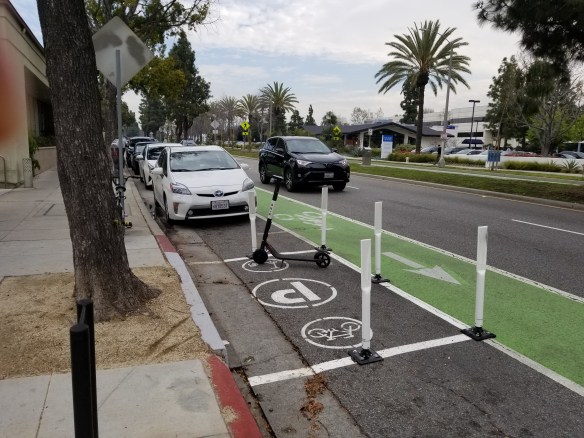
The City of Santa Monica has embraced dock-less scooters and bikes as an enduring solution to the last mile transportation issue by creating parking for dock-less vehicles where car street parking would normally go. Owners should also encourage the dock-less revolution by also creating parking for dock-less vehicles in their parkway or in the front of their properties.

Wheels.com’s All Electric Bike Enters The Last Mile Transportation Revolution Along with Dockless Bikes and Scooters .

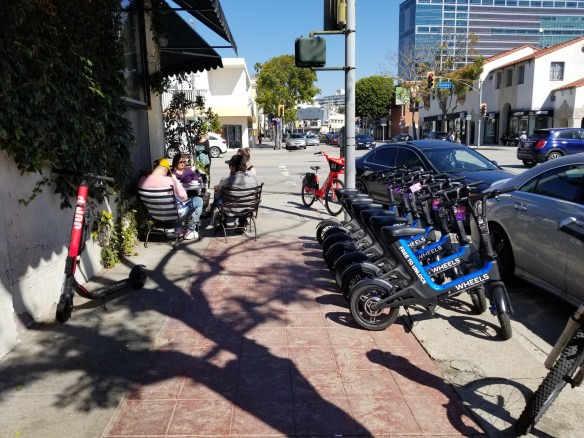
This week Wheels.com introduced a dockless all electric bike throughout Westwood and Brentwood. Today, dockless scooters along with semi and fully electric bikes crowd Westside sidewalks to offer a solution to short commutes. Many students and urban millennials are abandoning their cars for these alternative transportation devices. A one or two mile commute from campus, transit or home can now be accomplished with these omnipresent devices. One can pay $6 dollars for an Uber or Lift to travel one or two miles or $1.50 for a scooter or bike. These scooters and bikes are hassle free and cost less than parking in many cases. Those properties within two miles of a subway or light rail, campus, major office center, entertainment districts or desirable amenities–will take on greater value.  The City planned for bike racks, but now we may need scooter parking.

Planners have for decades promoted bikes as an alternative to driving and as a way to close the gap on short commutes–especially that last mile or two from a subway or light rail.  Tech companies have now closed the gap beyond the planners’ dreams.  We shall now see how enduring and what impact these devices have on the urban scene.  We must now deal with the task of making these alternatives safe and convenient.  Remember that in the early days of the automobile–many thought cars unsafe and very upsetting to the horses.