Unknown's avatar

About PMI Properties

PMI is a thirty year old property investment company located in Beverly Hills/Bel Air that invests in commercial and residential real estate. Since its founding in 1978, PMI Properties has closed over $500 million in office, shopping center, industry and apartment properties throughout Los Angeles and San Francisco. PMI's most recent endeavors have focused on pioneering creative office suites in office buildings and converted warehouses.These properties have been primarily located in Los Angeles and recently in San Francisco. PMI had its roots in investing in apartments, but more recent investments have focused towards offices, creative offices and converted warehouses. PMI was the first to pioneer a new, creative suite in office buildings with its proprietary "lifestyle suites," which featured skylights, partial hardwood floors, designer lighting, raised ceilings, interior glass, and other upgrade features. PMI pre-built the suites in an efficient and generic floor plan that not only achieved a premium, but also rented faster than suites requiring build-to-suit modifications. PMI was also one of the first to convert warehouse industrial facilities into flex creative space prior to the Internet boom. Today, PMI's suites are some of the most coveted creative offices on the market. Subscribe to get our newsletter and blogs for free! http://eepurl.com/hG0V2

Making Conventional Offices Creative

Creative office is hot.  What was considered a fad and unpractical just 15 years ago, is now becoming main stream.  Pension funds and investment advisors who once only bought class A highrises, have recently pursued creative offices in major growth markets.  Creative offices buildings are achieving sub-10% vacancy rates while many conventional office buildings have vacancy rates hovering closer to 20%. Companies outside technology and entertainment look to emulate the efficiencies and collaborative environments achieved in creative offices. Today, people can work everywhere.  The office needs to be more interesting and interactive.

In markets where tenant demand for creative office is strong–(San Francisco and Los Angeles), property owners of conventional space, especially class b and c vanilla offices, are trying to find ways to make their space appeal to creative users.  One way involves deconstruction:  exposing the natural building elements–like steel, ducting, or concrete. Another involves removing the suspended ceiling and creating an open ceiling plan with greater volumes.

Gensler proposes another way:  cut and remove floors to create  atrium.  The owner will lose footage but gain much more interesting space.  We did this 15 years ago when we re-developed Penn Station in Santa Monica.  We cut away sections of the second floor to create expansive first floor volumes for  this aging and tired 75,000 R&D warehouse in Santa Monica.  By also exposing the wood structural ceilings as well as concrete floors, we created a dazzling atrium:
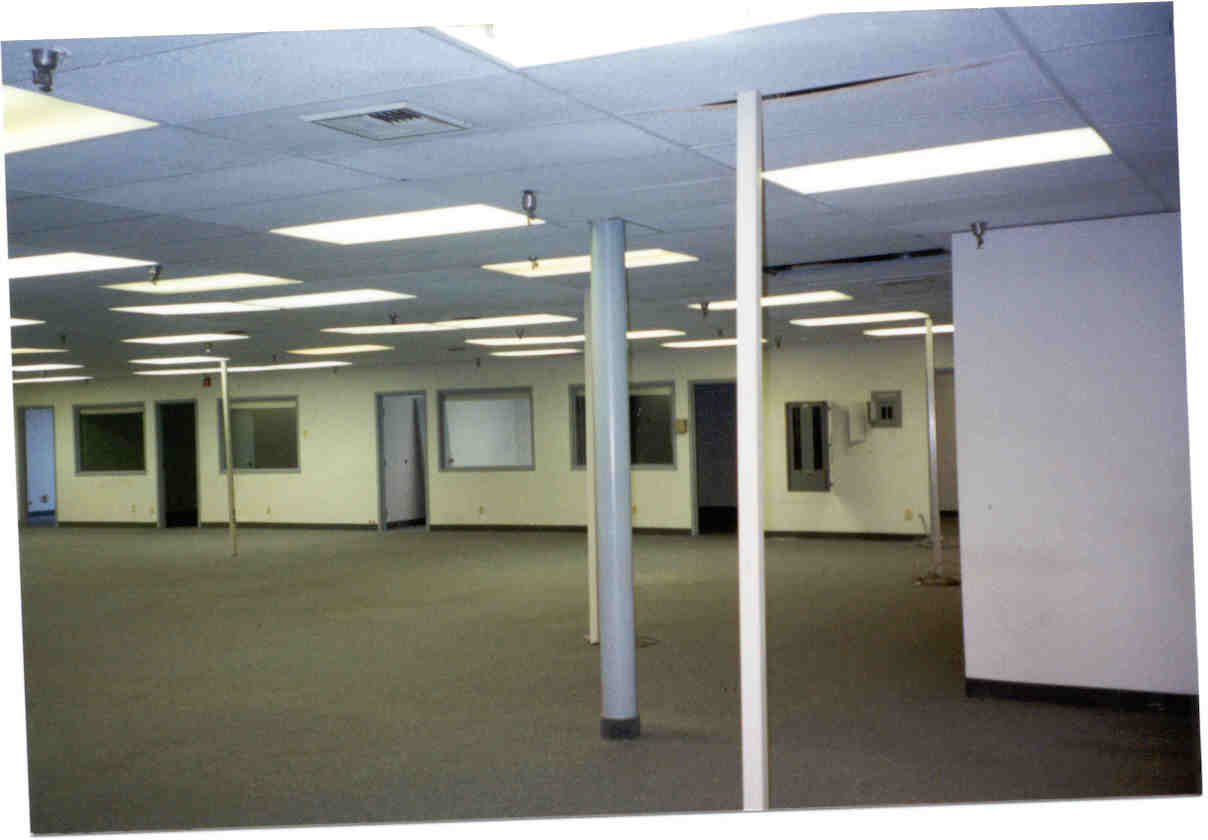
Before Atrium

Before Atrium

After Atrium

After Atrium

After Atrium 2

After Atrium 2

Gensler did this same technique in a boring three story bank building in downtown Los Angeles.  .

In a recent LA Times article, Gensler discussed the issue:

“Making underused office properties desirable again may require radical modifications inside and out, real estate experts say. Few owners have taken bold actions yet, but architects and urban planners are scheming about how such transformations might be accomplished.

Cutting out chunks of an office building’s interior to create an atrium or theater, adding loft-like mezzanines on floors with high ceilings or grafting on outdoor staircases are among the ways that structures could be dramatically remodeled to be more efficient and appeal to changing tastes.”

You can read the full article below. Plus, the article has a 360 degree interactive picture of Gensler’s new downtown Los Angeles headquarters.

via Big changes are coming to conventional office buildings – latimes.com.

New Gen Y Clusters in Los Angeles Neighborhoods

People like to live near people, business, lifestyles, amenities that fit their image and own lifestyle.  In other words, people like to live near people like themselves. Business like to locate near people who will use their services, and people like to live near businesses who services they use. As these people and businesses locate near each other–a cluster forms.  The more people and businesses, the stronger and more attractive the cluster.

Los Angeles is a large city of 4 million people.  It offers a host of options and many different neighborhood clusters.

Silver Lake and Echo Park offer a neighborhood where hipsters can cluster.  I don’t want to get into a discussion of what is a hipster.  You can read articles like this one to help:  http://articles.latimes.com/2012/jun/18/nation/la-na-nn-has-america-reached-peak-hipster-20120618 . 

Generally, Gen Ys who live in Silver Lake and Echo Park tend to be in the creative arts, like a certain form of Rock Music,wear unique clothing; enjoy small boutique shops over chains and vintage clothing over upscale designers; prefer some unique character to their housing; and  dig randomly meeting people they know while walking on the street or in cafes.  They may still like the beach but are not compelled to live near it (20 miles is close enough).  These northeasters do not mind the economic diversity still present within their neighborhood.

Westside Gen Ys tend to enjoy the safety, economic homogeneity, cleanliness,  and amenity rich characters of their neighborhoods.  The weather is cooler,and most everything they need to get to is a short commute. They don’t need their amenities in walking distance as long as it is a short drive with available parking. These west-siders enjoy the proximity to the beach and infinite choices in restaurants, bars, and shopping.

Hollywood offers an outrageous amount of bars and clubs and entertainment venues.  Downtown offers an urbane urban experience while still being able to get to other Los Angeles amenities by car (during non-rush hour). Downtown offers  the ability to rent or own a loft at a relatively more affordable price. Downtown has a diversity of clubs and appeals to the ecletic.

I apologize if I stereotyped or overly generalized these neighborhoods.  The purpose was to provide some  overview for why some Gen Ys may prefer one neighborhood over another in their housing choice.  Once started, these clusters are self aggrandizing.

Is Tech Slumping, Pausing, or Shifting

The LA Times last week ran an article that tech is slumping as evidenced by declining revenue at Google, Microsoft, Oracle, and Apple.  At the same time Facebook’s stock reaches $40 and Uber raises $258 million on a $3.5 billion valuation. There is a definite shift from PC to mobile.  The article cited the ipad’s slowing sales–but tablet sales in general are still rising.  It does not appear that any other publication picked up on the LA Times story.  You can read thei LA Times article below.


Tech industry slips into a surprising slump – Page 2 – latimes.com.

The Collision of the Great Recession and Echo Boomer Demographics Causes Shifts in the Urban Landscape

In early 2010, we forecasted the following, “the previous expansion was based more on financial innovation and housing wealth accumulation, whereas the next expansion may see a second rebirth of technology and other knowledge-based innovations more similar to the 1990s and further exploitation of the globalization.”

The Great Recession caused many Echo Boomers to forestall household formation by doubling up, staying with parents,  living with roommates, staying single, and remaining childless.  Echo boomers saw housing prices fall.  At the same time,  we all witnessed the birth of the social network, information anywhere and anytime, the rise of search, collaborative consumption, and the new power and dominance of mobile technology via tablets and smartphones.  The economy slowly recovers.  Energy and techology has led the way.  Certain Gen Y’s, especially those in knowledge industries, are getting jobs or promotions and starting new households.

The disparity of wealth accelerated between knowledge workers and non-knowledge workers.  Super knowledge regions grew prosperous while other areas floundered.   Contrast San Francisco with Detroit.

The knowledge working Gen Ys now want to stay connected not only electronically but physically.  They have forestalled marriage and children and pursue their social lives.  This trend has manifest in the desire for walkable and amenity rich cities with  plentiful entertainment, bars, restaurants, strolling streets, and cafes. If they can’t have great private spaces in their homes, they want great public spaces offered in certain cities.   Knowledge workers are now flocking not only into cities within these knowledge super regions but into new neighborhood clusters where they can achieve a real “Social Network.”

San Francisco split by Silicon Valley’s wealth – latimes.com

The housing activists are complaining that the tech workers are driving up rents and squeezing out “middle class families, small businesses, artists, and intellectuals.”  I guess the tech guys are not intellectuals.  According to Real Facts LLC, the average asking rent of a one bedroom in San Francisco is $2,797 (LA Times. Aug 14 2013, page A8).  According to Enrico Moretti in the New Geography of Jobs–every tech job produces 5 service jobs.  A lot of cities in the United States would like to have a successful tech sector like San Francisco.  It’s too much of a good thing.  You can read the entire article below.

San Francisco split by Silicon Valley’s wealth – latimes.com.

Why San Francisco May Be the New Silicon Valley – Richard Florida – The Atlantic Cities

Another article by Richard Florida  shows the rise of the City of San Francisco as tech hub that shares venture capital funding with the Silicon Valley:

“The sheer number of large clusters of investment in the maps make it clear that venture capital in Bay Area is no longer primarily or predominantly centered in the quintessential techie hub of Silicon Valley. San Francisco has been catching up: The biggest dots by far – indicating the greatest volume and concentration of venture capital activity investment – appear to be in and around the center of San Francisco.”

Florida sees this sharing of money by the suburban Silicon Valley with the urban San Francisco as further evidence of a shift to dense cities versus urban sprawls.  Even within the Silicon Valley, he shows more venture money going to companies in the urban versus suburban parts of the Valley.

However, more interesting is how Florida shows how the two feed off each other to create a mega tech region:

“Of course cities and suburbs are not either/or propositions when it comes to startups, venture capital and high-tech in the Bay Area. If start-ups thrive in dense, diverse urban center cities where talent clusters, serendipity thrives, and services can be found in the surrounding neighborhood, large established companies like Google, Apple and Facebook need the space that their suburban campuses provide. The locational symbiosis is reflected in the shuttle buses these companies have long run between their suburban campuses and downtown San Francisco, where more and more of their workers prefer to live.”

Why San Francisco May Be the New Silicon Valley – Richard Florida – The Atlantic Cities.

Has Marina Del Rey Lost Its Creative Office Mojo? It’s The Cluster, Stupid.

We and other creative office developers started converting warehouses to creative office in Marina Del Rey in the mid 1990’s. The Marina was the next hot creative office area after Santa Monica. Creative companies escaped Santa Monica’s high rents by moving to Marina Del Rey creative office conversions. Most of the activity took place in the industrial area between Lincoln Boulevard and Redwood Avenue and Washington Boulevard and Maxella. At one time,  there was over 1 million square feet of creative office space in the Marina. In early 2001,  the dot com boom turned to bust; many tech companies failed, and vacancies surged. However, it was not the dot com bust that led to MDR’s loss of mojo. It was the housing boom. A land mine in the area’s zoning code allows twice the density for residential than commercial. Thousands of condos and lofts were built in the early and mid 2000’s. Some creative offices were demolished to make way for residential development.   Housing developers would pay a lot more for warehouse properties than creative office renovators would pay. The demolitions and absence of new creative office product caused the cluster of creative office companies to diminish. More exciting product was being developed in Culver City and now in Playa Vista. The MDR area is now called the Loft District or Artist District (there are no artists but just lofts that successful artists may live in). Despite all the rich amenities and growth in residential, the number of creative companies in the Marina has declined over time.  Make no mistake, creative companies like to cluster around each other.   Without a cluster–despite other amenities like restaurants–creative office cannot flourish.

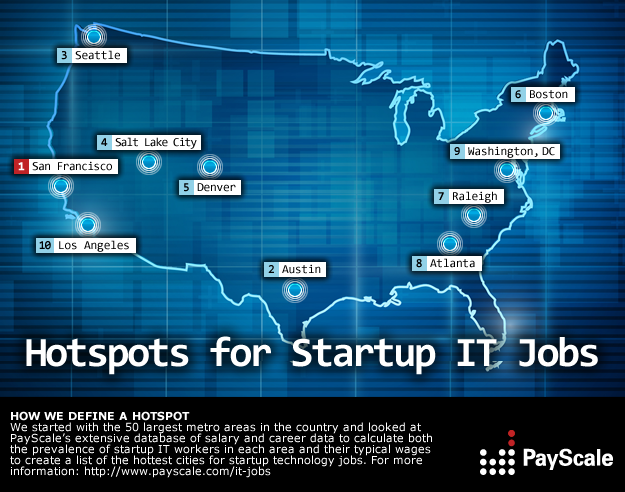
Map: The hottest spots in the U.S. for startup tech jobs – GeekWire–Los Angeles Continues to Lag.

hitechhotspots_image03

This article below from last year shows Los Angeles as low as number 10 as a hotspot for tech start-ups.  This contrasts with the dot com boom where Los Angeles was a solid four.  A lot depends on how one slices and dices data.  When you look at Los Angeles Orange County as a region, it ranks number 3 to 5 in venture funding ( depending on the quarter) according to Money Tree Price Waterhouse.  However, the rank falls percipitiously when you look at just  software venture funding as this area is driving the urban tech boom.  A recent article by Richard Florida put Los Angeles.  An article by Richard Florida, published in the Atlantic Cities (June 13, 2013), America’s Leading Metros for Venture Capital, shows the Los Angeles Metropolitan Area as number 5.

Map: The hottest spots in the U.S. for start-up tech jobs – GeekWire.

Conference in L.A. reflects city’s rise as ad industry hub – latimes.com

Advertising drives a lot of creative office demand.  From the production of commercials to digital firms like Adly.com- Westside has many firms related to the advertising agency.  The Westside creative office directly benefits when this industry grows.  The articles discusses the growth of LA rise as an advertising industry hub.  The Los Angeles growth arises from its  proximity to multiple marketing platform including television, movies, gaming, as well as the convergence of entertainment and technology thru new distribution channels like You Tube, Hulu, and Netflix.

Conference in L.A. reflects city’s rise as ad industry hub – latimes.com.