Forbes Blog Attempts to Crown Los Angeles Ahead of Silicon Valley in the Startup Race

We might be so bold as to say that Los Angeles surpassing Silicon Valley in the startup race is not going to happen.  However, this recent article in Forbes does not actually discuss the placement of Los Angeles or Silicon Valley in the startup race. Instead, it speaks of the resistance one marketing tech worker had in moving to Los Angeles from San Francisco.  Despite the misconceptions that some Silicon Valley residents may have about the tech and startup scene in Southern California, this article points out that there is a lot of promise in Los Angeles.  A good argument that is made in the article is if L.A. wants to gain a traction on a higher spot in the tech startup race, there needs to be more tech talent that is interested in entrepreneurship.

All differences aside, we have a lot of tech in Los Angeles.  If aerospace technology were to be included, we may blow away Silicon Valley.  During the dotcom boom, Los Angeles had the number four spot in venture capital funding behind Silicon Valley, Boston, and New York according to the National Venture Capital Association.  Guess What?  We still have the number four spot.  As the technology industry comes back as a whole, Los Angeles tech is coming back as well.  We are rebuilding the infrastructure we had during the dotcom boom.  Although some valuations may appear bubbly–venture funding does not even come close to rivaling the dot com boom.  Venture funding reached $99 billion in 2000 versus $28 billion in 2011.

Los Angeles will not catch up to the Bay area anytime soon in technology and startups, and conversely, the Bay Area will not catch up to Los Angeles in the movie and media realm.  Both have too much history, infrastructure, institutions, and alumni in each of their respective areas of domination.  Los Angeles can excel in the niche tech areas of content convergence, such as Hulu and Demand Media.  LA can also do extremely well in advertising and marketing tech (Adly), and ecommerce (Shopzilla, Fandango).

Incorporating Coffee Shop Ideals in Creative Office Space Design

An article from Gensler was published recently which discusses what we can learn from a coffee shop relative to the current design of office spaces.  One observation the article mentions is to have people sit facing away from walls.  When you go into a coffee shop alone and select a seat–you will typically take the seat with your back against the wall and facing out.  Gensler concludes that this is the way most people prefer to work.

The article further talks about this method being implemented in one of their studies with fantastic results.  The seating approach used has increased collaboration in the office.  The way people sit at their desks and can be seen by others allows people to better notice when someone else is available talk or work with.  With increased collaboration and respect among employees, this workplace becomes a more comfortable and enjoyable place to be.

The article also points out that different generations of people tend to exhibit the same tastes in regard to seating and working at a coffee shop.  This too, can be great for a company that is wanting to transition to a open plan.  Knowing that workers of different ages don’t greatly differ in their office style work space tastes will help make the decision to change the layout of the office an easy one.

There are seven points to this article to take into consideration in remodeling or designing creative office space.  Companies may experiment with these ideas and possibly make an effort to modify the office plan in order to increase collaborations and creativity throughout the workforce.

We have not tried any of these ideas out.  However, we have seen the importance of the kitchen and break area grow.  In one 12,000 square foot suite, we built two kitchen and break areas.  In another 10,000 square foot deal, the tenant refused to move in until the kitchen break area was totally finished because the tenant viewed it as a critical part of the space.

Corporations Aim to Merge Creative Space with Newest Startup Acquisitions

PMI has edgy creative buildings with a lot of startups as tenants.  These startups are attracted to PMI’s creative spaces in smaller buildings.  We emphasize great architecture and build communities for the tenants to interact with each other.  Many of our tenants over the years have been acquired as a method of their exit:  Applied Semantics, AZ Razorfish, Guardian Edge, Apture, Playdom, Techcrunch, and Doubleclick to name a few.

Once these firms are acquired, the corporations want the firm to integrate into the ‘mothership’.  They will either wait for the new acquisition’s lease to expire, try to sublease the space, or offer a buyout option.  These large corporations have facility managers who also demand a different set of services.  They want a state of the art security service and will sacrifice the edgy aesthetics to achieve it.  Sometimes the acquired company fights for their independence within the corporate structure.  These companies want to keep an identity and culture separate from the acquirer.  Zappos is a classic case of such a company.  They stayed true to their culture when they were acquired by Amazon.  In fact, Amazon actually strongly encouraged Zappos to stay true to their roots– it was part of what made them so unique and special in today’s Internet marketplace.

Another example is that in PMI’s buildings, Techcrunch renewed their lease versus moving into an AOL facility.  Keeping their old digs was one way for Techcrunch to retain their independence from AOL and maintain a separate culture at the same time.

Overall, corporations keep their goal of wanting to move the new startup acquisition to a space that falls more in line with the main, home office of the corporation.  This occurs at the same time as having the startup stay true to their founding identity and what made them so attractive to acquire in the first place.  A balance between the two needs to be maintained and sometimes it is a fine line to reach.

Innovative Companies Undergo Artistic Renovations to Maintain Creative Edge

A recent article published from Bloomberg.org discusses the rise of creative space throughout major cities.  The resurgence of the digital technology sector has created a demand for this type of creative office space.  This time around, major developers and institutional investors acknowledge this trend and have driven down the yields on this product.  Certain features of the space are leading to new ways of working, especially for firms with employees who spend a lot of time on computers or mobile devices.  This is a shift from a traditional office environment where employees focus their time in small conference rooms or on the telephone.  At PMI, we continue to strive for our spaces to promote creativity, collaboration, and the ability to scale if needed.

In all of about 15 years in Los Angeles, there were only about three or four developers doing this. PMI was one of them.  None of them were institutions.  It was hard to get financing as the lenders believed this type of office design was a fad.  PMI was able to buy Marina Studios because the lender who foreclosed could not figure out what exactly Marina was or how it should be used.  It did not work as an industrial building and it did not look like offices.  PMI was able to take control of the building, effectively design and market it, and we now currently maintain a fully leased building.

The full article outlines more of the characteristics of these new, emerging offices.

Loss of L.A. Art & Entertainment Jobs Explains Sluggish Westside Creative Market–But Digital Tech Continues to Surge On

The Otis College of Art and Design commissioned a report for 2010 which was compiled by the Los Angeles County Economic Development Corporation.  The report shows a loss of 80,000 jobs in Los Angeles creative industries from 2007 to 2010.  Only digital media employment managed to remain steady over the same period.  Since creative workers occupy creative office, these statistics explain the absorption losses in L.A.’s Westside creative office market.

What about 2011?  Our calculation of the Los Angeles creative industries (excluding informational services) reveals a gain of only 1,200 jobs from November 2010 to November 2011.  This percentage gain, under one half of one percent, corresponds to the sluggish leasing recovery in the greater Westside creative office buildings.  In constrast, information services alone gained 5,200 jobs– an increase of over 65%.  This job explosion in digital technology has translated to a surging demand for creative office space, so far primarily in Santa Monica.

This article by Mike Boehm of The Los Angeles Times lays out all the findings of the Otis Report on the Creative Economy of Los Angeles and Orange Counties: LA Creative Jobs, LA Times Dec 20 2011.

Cultivating Inventiveness & Ingenuity in Creative Offices Today

From white boards to free digital applications that encourage collaboration and organization of work, companies are researching and enacting as many policies and practices as possible so they can to foster inventiveness and ingenuity throughout their employee population. This article from Behind the Counter explores four key strategies that companies are implementing to facilitate creative collaboration among their employees. They are simple tactics that any company can start using to encourage and support their employees to think differently. A company doesn’t have to be a heavy hitter like Google, Groupon, Living Social or Facebook to take advantage of these creative courses of action.

PMI Properties is proud to see most of their tenants already putting into practice at least one of these strategies with outstanding, innovative results. From collaborative areas to exploring new environments.  We are happy that our tenants are embracing these innovative trends.

Designing Offices for Digital Technology Companies

We rent office space on the Westside of Los Angeles and in San Francisco to digital technology companies.  Our tenants include or have included Twitter, Google, DoubleClick, Yammer, Scribd, Applied Semantics, Microsoft, and Eventbrite.  Much has changed from the dot-com days.  Today, the three factors that are important for the design of these spaces are creative environments, densification, and collaboration.  Spaces are open to allow for the ability to scale to densities of up to 10 people per 1000 square feet.  Although the company may start out at 4 people per 1000 square feet, the ability to scale within the space will enable to firm to expand without taking on additional space and without moving.  To allow this densification, the space should have good light, open areas, and a lot of power and outlets.  Higher ceiling volumes with open structural elements help reduce the feeling of being cramped into a tight area.  Although liner table arrangements are the most efficient, undulating plans have also worked and reduce monotony.

Diagram from the dot-com days.

Creatively remodeled office space.

In the dot-com days, designers used circular and angle offices to create visual interest.  Today, these designs reduce the efficiency of the floor plan.  Designers now use the natural beauty of the physical structure, colors, textures, and lighting to create visual interest.

Large, high partition work stations have given way to interconnected non-partitioned tables where groups of designers sit together in close proximity.  Email, texts, and social networking have replaced audio phone use and hence eliminated the need for partitions.  Enclosed spaces are used primarily for conferences, group meetings, and other collaborations.  These enclosed meeting spaces average about 1 per 1000 square feet.

Yammer Collarboration Area at PMI's 410 Townsend in San Francisco.

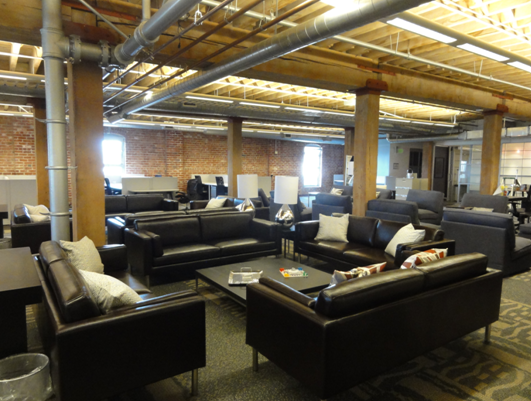
Collaboration spaces have become more important in offices today.  People are used to collaborating in cafés; now designers are incorporating the “café look” into the office design.  Today workers come from the Starbucks generation where coffee houses are iconic symbols of collaborative settings.

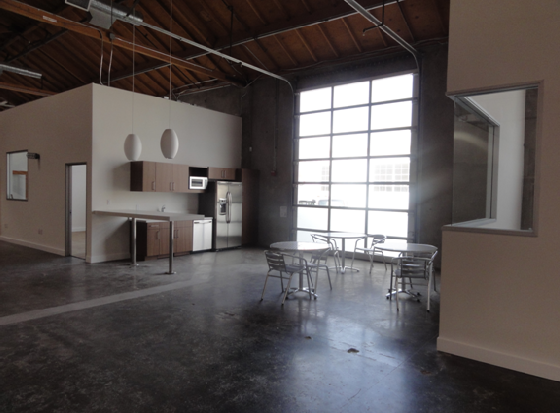
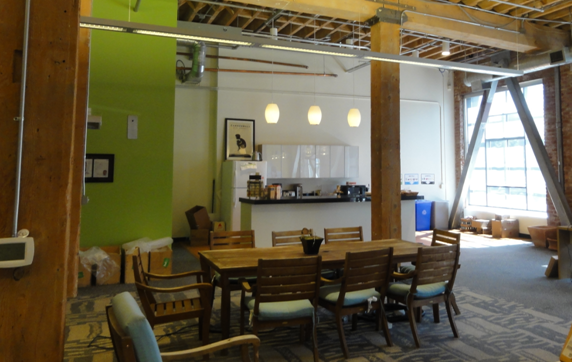
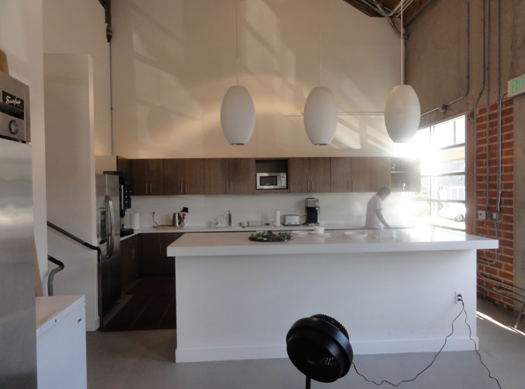
Kitchens have expanded into highly designed café settings in very visible locations.

Kitchen at PMI's 3525 Eastham in Culver City.

Kitchen at TechCrunch at PMI's 410 Townsend in San Francisco.

This is a refreshing contrast to the kitchens of the past, relegated to a hidden enclosed corner with vinyl floors and fluorescent lights.  Several companies, some as small as 40 people, have dining areas that can fit much of the company’s employees.  They also require company lunches several times a month or even a couple times a week.  Other examples of collaborative settings could involve a game room or juice lounge.   Instead of just one kitchen, there may even be multiple areas with sinks, refrigerators, and snacks.  This gives a modern spin to the popular water cooler meeting spot that all offices seem to share.

All in all, there are many designs and combinations that can be created for all the different types of tenants we house.  For PMI, we strive to meet all of our tenant’s requests and see to it that creativity continues to flourish among our properties and tenants.  Scroll down to see more examples of the creative space we have produced for our outstanding tenants!

Kitchen at Mitch Kapor's offices at 543 Howard in San Francisco.

Mahalo's Kitchen at PMI's 3523 Eastham in Culver City.

Eventbrite's former space at PMI's 410 Townsend in San Francisco.

Afar Media at PMI's 394 Pacific in San Francisco.

Tech Start-ups Flock to L.A.’s ‘Silicon Beach’

Tech is quickly spreading profusely over Los Angeles.  Northern California is no longer the only place where up and coming tech, web, and new media companies are calling home.  The L.A. Times recently published an article detailing companies and new tech start-ups who have made chosen “Silicon Beach” over “Silicon Valley.”

Some start-ups are also searching for suites in Los Angeles that are flexible and easy to remodel to fit their needs as a company.  One major tenant broker reported a flurry of requirements for companies that produce video content for the web.  PMI has received interest from a few companies that require building several of these web video studios.  PMI is trying to figure out how to best accommodate these needs by making the restoration of the space less expensive.  The companies who are requesting restoration believe that the renovated studio will have additional value for the next company who will occupy it.  However, in the event that the next company does not prefer the modifications previously made– maybe they are involved with a different type of business– the company will want the web video studio layout removed.  Adding to the complexity of the situation, these companies also have different studio requirements; there isn’t an adequate generic standard these studios can be crafted by.

PMI is working to accomdate all of their tenant’s requests, and are happy to welcome new and creative companies at their properties.  With the creation of Silicon Beach, we expect the creative office space demand to rise even further.

Five Santa Monica Office Buildings Sell for $90 Million

When PMI Properties helped invent the Los Angeles creative office business back in the mid-1990s, there was no institutional investment in creative office.  The institutions thought creative office was a fad and didn’t really understand the business.  Now Lionstone Group owns more than a million square feet of creative office space.  Hudson, Kilroy, Alcion, Divco, and many others are now buyers and developers of creative office spaces.

PMI has it’s share of tech, new media and production companies residing at our creative offices and we are rapidly expanding and accepting more tenants month by month.  To see the variety and scope of our tenants, click here.

The LA Times article here expands more on the creative office space boom.