There are definitely conflicting studies about the rising popularity of transit. The US Census results indicate that drivers continue to drive alone to work. .
There are definitely conflicting studies about the rising popularity of transit. The US Census results indicate that drivers continue to drive alone to work. .
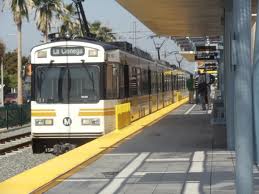
Here is some evidence that the Expo Line may be working. One study finds that after the light-railed opened, Angelenos who lived within a half-mile of a station tripled their ridership and reduced their daily driving by 40% (see study below).
I had a second experience. I parked in Culver City and took a relative to a show at the Los Angeles Convention Center. On the way, my relative declared that he does not take public transit and prefers to drive. However, as a Laker fan, I have learned he now regularly parks in Culver City and takes the light rail to the Staples Center. He even continued to do so after he once boarded the Blue Line on the way home by mistake.
At this point, most people I know use the light rail to ride and park in Culver City and take the Expo to the Staples Center.
Residents living near Expo Line stations reduce car use, study shows.

FROM BISNOW:
“In the Southeast, like the rest of the country, development is hottest in infill locations surrounded by complementary uses like retail and office (meaning there’s no mad rush to the ‘burbs). Josh has noticed developers catering to two key demographics: Millennials and retirees. Millennials’ more efficient use of space means smaller units and supercharged amenities like all-over WiFi and a clubhouse for socializing. The older crowd agrees on amenities but may lean more traditional within the unit, Josh says, preferring more formal rooms (versus a loft space, above) that reflect how they grew up.”
Evan Stone and Jack Dorsey of Twiitter on the Roof of PMI’s 539 Bryant building circa 2009. 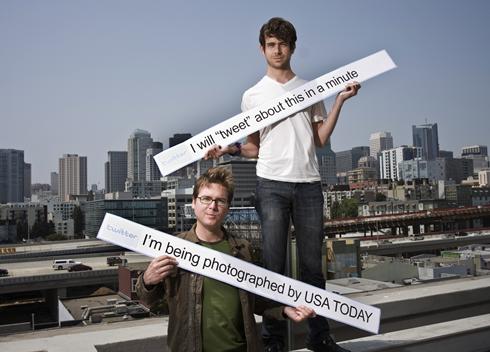

Can be a creative office or a creative apartment
The young workers who are attracted to creative office will also be attracted to the same design features in their apartments. The same principals that make creative office popular in the work environment will also make creative multifamily popular in the housing environment. Exposing structural elements, creating indoor outdoor space, and raising ceilings will make otherwise boring apartments cool. In Los Angeles, many are already attracted to loft living in Downtown, Venice, and Marina Del Rey. Adding some of the features in creative offices to the typical apartment units that predominate Los Angeles can turn boring and tired spaces into more interesting creative spaces. Los Angeles apartments consists of popcorn or drywall ceilings and laminate and or carpeted floors. Adding creative space elements will instill a different vibe. The new features may include wood or concrete ceilings, glass roll up doors, brick or writable walls, and polished concrete floors. Creative office and creative apartments will merge into a creative space movement. The space will be useable for both live and work, (an apartfice). Several start-ups have rented one apartment unit for the office and others for living and working in the same complex. These small start-ups use the space interchanageably–living, working, or both as needed. Cool space is cool space.

Open offices have become very popular. However, conversations or telephone calls can disturb open office users. Many open office users resort to headsets to create a quiet zone. The headphone market has exploded. Headphones and listening to white music can help the problem of noise interruption in an open office plan. Perhaps, headphones that are not complete noise cancelling are better since communication is still possible without needing the person to remove the headphones. The open office plan allows for greater collaboration and density. Headphones are the defacto method that open space users use to deal with noise. It may be useful to tie the headsets into the phone system so workers can take calls on their headsets. The headphones will become an integral tool in the open office plans and will be specifically designed for this use. Do I see a joint venture between Dr. Dre and Herman Miller?

A number of spontaneous activities occur during the workday that require the need for private spaces within an open floor plan. People need to take calls ,unexpectedly talk to a colleagues, engage in a heated conversations or conversation that should be kept private.
Although in some cases these conversations can motivate collaboration, in other cases, these conversations will cause disruptions to others.
It may be inconvenient to have to travel a distance to a conference room for a short spontaneous need. Inconvenience encourages people to ignore etiquette and disrupt other workers. We recommend telephone rooms and/or very small conference rooms dispersed in and around the open work area so that these private areas are easy to get to and convenient. In contrast, we would not recommend that these private areas be concentrated in just one part of the office. Workers will be more likely to use the facilities to just take a short call or conduct a fast conversation if they are brainlessly in close proximity.
Open office plans give rise to a host of issues regarding noise, distractions, and privacy that needs to be addressed. Knoll has provided a whitepaper on establishing guidelines for appropriate open office behavior. See below:
ules for Etiquette in the Open Office | Workplace Research | Resources | Knoll.
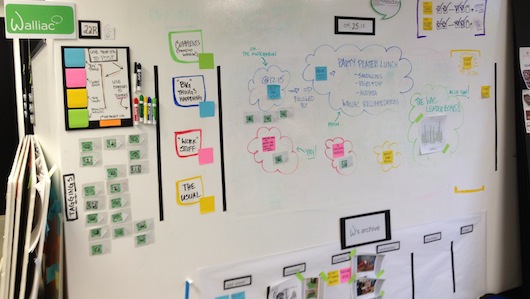
White Board Paint on A Wall
Many of our tech tenants are now specifying dry erase paint on some or all walls as part of their tenant build outs. Dry erase paint (or white board paint) turns a wall or table or door into a surface you can write or draw and erase like a whiteboard.. We have often wondered why not just use a whiteboard. Dry erase paint gives you a larger and more impromptu surface to mark up and erase. Further, we believe tenants like the novelty of the product. A 4′ x 6′ whiteboard would cost around $185. Although 40 square feet of Idea Paint, a brand of dry erase paint, would cost $80–you would still need to factor in the cost of installation. Many of our tenants argue it is just paint and can be applied like paint. However, it is not just paint. For it to work, you need to follow very specific application instructions. By the time you figure in the cost of application, we believe the finished price per square foot would be very similar to whiteboards at the $8 per square foot range.
Our contractor uses Rust-Oleum Dry Erase Paint which cost only $20 at Home Depot and covers 50 square feet. We believe that our tenants have had favorable experiences with this lower priced product, although there is some bad buzz about it on the web. This article also claims success with the Rust-Oleum:
Try This: Paint A Wall With Dry Erase Paint – A Beautiful Mess.
Here is an Idea Paint whitepaper on uses of white board paint in the office. Advocates claim that a wall that can be marked up leads to better collaboration. Colleagues can better add to ideas left up and viewed on the wall: You can read more at the link below.
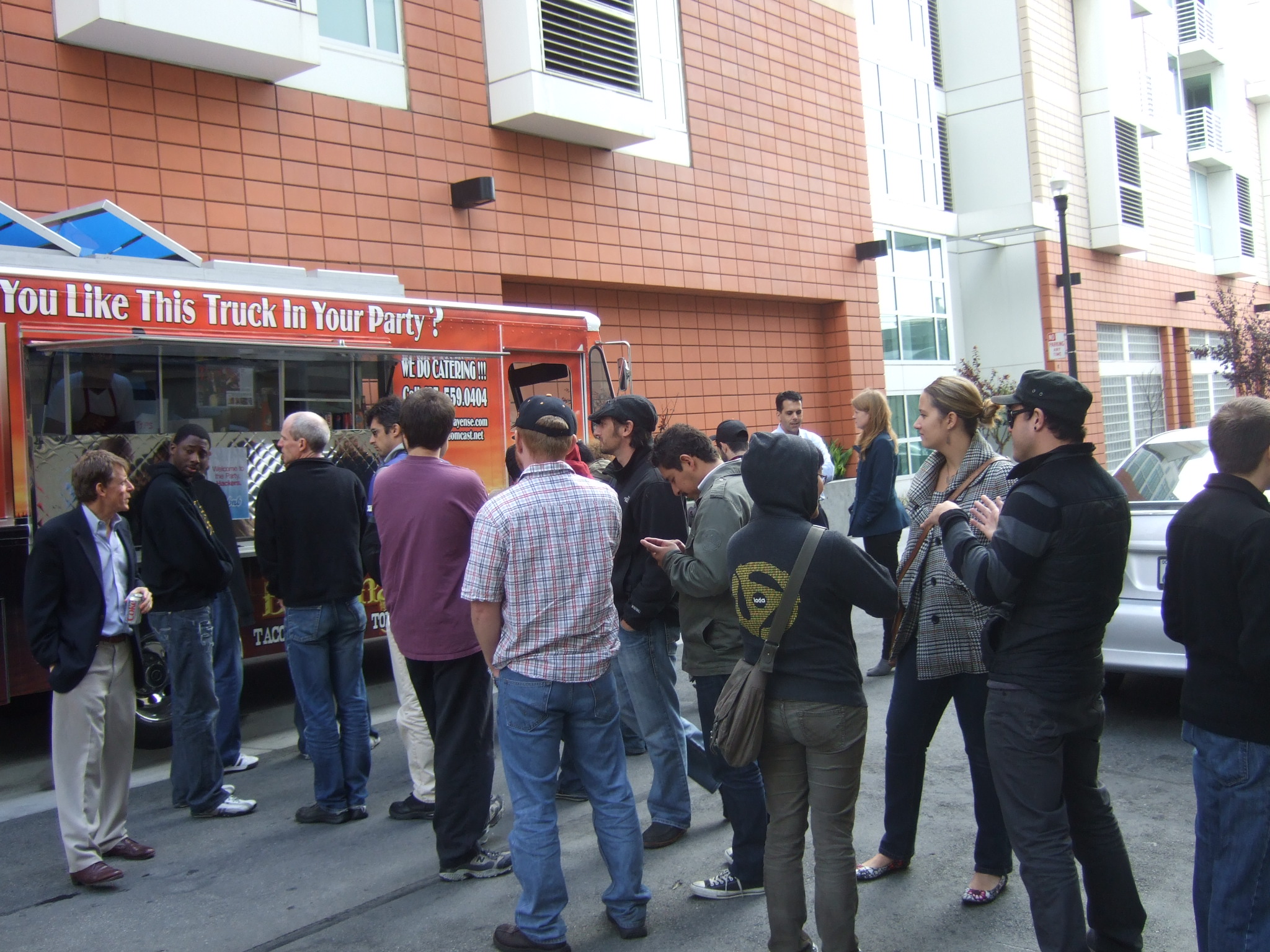
Despite gourmet lunches catered by Tech Companies located in PMI SOMA San Francisco Office Building, Tech workers line up to get a free taco from a popular food truck vendor.
In Los Angeles, warehouses make excellent creative office conversions because of their high ceilings and industrial features. However,the neighborhoods with these creative office candidates typically do not have many restaurants or food amenities in easy walking distance. One example is the Hayden Tract in Culver City that has numerous warehouses converted to creative office. However, the area has only one or two restaurants in walking distance. True, Downtown Culver City and the Helms area with numerous exciting food and beverage options are a short drive by car. Culver City has ample parking in these areas.
Many employers and employees have expressed that most of their employees do not want to drive to lunch. Yes, they will drive for a business lunch or occasional change of pace. Yes, these drivable restaurants and bars offer an excellent after work amenity. However, many creative office workers do not have time to go to a long lunch. These workers bring their lunch, and some employers have lunch catered in for their creative workers. These creatives would welcome a variety of alternatives to catch a fast lunch time bite. These food amenities increase the desirability of the area. As the area grows, and if zoning allows, more restaurants and food amenities will appear.
In the meantime, food trucks can provide a temporary solution to lunch time boredom. Once only used by construction workers, food truck have gone gourmet and appeal to a more discriminating pallet. Further, food trucks can rotate and provide a wide variety of alternatives.
Professor Kung of UCLA shows foot trucks provide variety, and variety is desired by office workers. Kung discusses the benefit of food trucks for office workers with limited brick and mortar options:
“Without food trucks, his only options are the set of restaurants nearby, which are the same every day. With food trucks, his options are increased, and the food trucks outside his office can be different every day because food trucks are mobile. Foodtruck mobility allows the same number of restaurants to serve a greater number of customers,and increases the variety of food options available to each customer.”
You can read the full article below:

Soft Creative Offices
Eighteen years ago, I was told that creative offices were a fad that would go away. Just after the dot com bust, it almost seemed like it would go away. However, creative office is the de rigueur, not the exception. Absorption and occupancy for creative office is rising; absorption and demand for traditional office is falling.
So many owners with traditional offices are attempting a conversion to a “soft creative office”. In soft creative, many of the aspect of open and collaborative space planning are incorporated with exposition of the natural elements of the building, including exposed higher ceilings. However, not all tenants have embraced “creative offices”. You may, in fact, alienate your more traditional tenants as you transition to a more informal, creative environment. This problem is similar to the problems encountered when mixing medical and general office tenants.
PMI Properties is in the process of transitioning a traditional office building in WLA into a soft creative office building. Creative tenants now occupy 70% of the space, and traditional tenants occupy the balance of the space. We have introduced creative design elements and furnishing into this formerly traditional office building. These elements, among others, include polished concrete or hardwood floors, and exposed steel beams. We replaced the acoustical ceilings with drywall and the 2 x 4 foot parabolic lighting with recessed lights or indirect pendants. We elected not to go with an exposed ceiling so as to appeal to a wider variety of tenant and avoid problems with fireproofing the lid.
We have received push back from some of the traditional tenants as to some of the features desired by creative tenants as well as to the creative tenants themselves:
“Does PMI really think that the newly-installed ‘swimsuits optional’ artwork opposite the restrooms on our floor are appropriate in a business office environment? While it does somewhat correlate with the ‘beach’ theme of the other artwork on our floor, it certainly projects a rather unprofessional image, and surprises me that [name deleted] would choose it and PMI would install it. It seems more like something that the boys in 204 might put up in their suite to go along with their ping pong table and office beagles.
Also, how much longer is the Foosball table going to be in that hallway? It’s been there nearly a month now, maybe longer. Do you know why it’s there, who it belongs to, and what the plan is for getting it out of the common space?”
So my suggestion is to prepare to lose some tenants when transitioning an office from traditional to creative or introduce elements that both can live with. However, in the later case, you may end up with something that truly satisfies nobody.
 PMI Properties