Innovative Companies Undergo Artistic Renovations to Maintain Creative Edge

A recent article published from Bloomberg.org discusses the rise of creative space throughout major cities.  The resurgence of the digital technology sector has created a demand for this type of creative office space.  This time around, major developers and institutional investors acknowledge this trend and have driven down the yields on this product.  Certain features of the space are leading to new ways of working, especially for firms with employees who spend a lot of time on computers or mobile devices.  This is a shift from a traditional office environment where employees focus their time in small conference rooms or on the telephone.  At PMI, we continue to strive for our spaces to promote creativity, collaboration, and the ability to scale if needed.

In all of about 15 years in Los Angeles, there were only about three or four developers doing this. PMI was one of them.  None of them were institutions.  It was hard to get financing as the lenders believed this type of office design was a fad.  PMI was able to buy Marina Studios because the lender who foreclosed could not figure out what exactly Marina was or how it should be used.  It did not work as an industrial building and it did not look like offices.  PMI was able to take control of the building, effectively design and market it, and we now currently maintain a fully leased building.

The full article outlines more of the characteristics of these new, emerging offices.

Bebo.com to Relocate Corporate HQ to PMI’s Creative Office Building in West Los Angeles

PMI Property is proud to announce that Bebo.com, the social networking website, signed a 2,000 square foot lease to relocate it’s headquarters to the creative office building at 10951 Pico Boulevard in West Los Angeles, California.

Bebo was catapulted onto the social networking scene and embraced by users in 2005.  It can be considered one of the first examples of creating a successful social networking site.  Unfortunately, Bebo was quickly overshadowed by MySpace.  Then Facebook launched, and the social networking revolution we all know today exploded.  AOL purchased Bebo in 2008 for $850 million and sold it to the current owners for under $10 million in 2010.  The original founder Michael Birch netted $300 million on the deal after investing $8,000 to start Bebo.  The current owners operate Bebo as an international social meeting website, and it boasts over 400,000 unique visitors a month in the United States alone.  Bebo still has to compete with the giant of the social networking game: Facebook, with their 140 million unique monthly visitors.  In contrast, Friendster is down to 77,000 users a month.

But Bebo survived, and has fared well in comparison to other sites. They feature personal profile pages for users where they can post blogs, photos, music and videos, as well as online gaming.  Be sure to check out our new tenant, Bebo to see what they have to offer!

You can read more about Bebo.com here.

Loss of L.A. Art & Entertainment Jobs Explains Sluggish Westside Creative Market–But Digital Tech Continues to Surge On

The Otis College of Art and Design commissioned a report for 2010 which was compiled by the Los Angeles County Economic Development Corporation.  The report shows a loss of 80,000 jobs in Los Angeles creative industries from 2007 to 2010.  Only digital media employment managed to remain steady over the same period.  Since creative workers occupy creative office, these statistics explain the absorption losses in L.A.’s Westside creative office market.

What about 2011?  Our calculation of the Los Angeles creative industries (excluding informational services) reveals a gain of only 1,200 jobs from November 2010 to November 2011.  This percentage gain, under one half of one percent, corresponds to the sluggish leasing recovery in the greater Westside creative office buildings.  In constrast, information services alone gained 5,200 jobs– an increase of over 65%.  This job explosion in digital technology has translated to a surging demand for creative office space, so far primarily in Santa Monica.

This article by Mike Boehm of The Los Angeles Times lays out all the findings of the Otis Report on the Creative Economy of Los Angeles and Orange Counties: LA Creative Jobs, LA Times Dec 20 2011.

The Affordable Housing Dilemma in Los Angeles

The market for affordable rental properties in the greater Los Angeles area has become a tricky question with an increasingly problematic solution.  If you are lucky enough to get a tip about a reasonably priced dwelling, chances are hundreds of other people did too– and you might just be too late.  The demand for affordable housing in Los Angeles outweighs the quantity that is actually available. The lack of sensibly priced rental properties has become somewhat precarious for residents.  Some people are going to extreme measures to provide what they consider as affordable housing.  One the other hand, some disagree that these properties are too small and crowded.  They feel that the landlords of these buildings are walking the line of illegal and immoral activities.  Hopefully the L.A. Housing Authority will step in and prevent this from happening again.

There are people taking the lack of space in Los Angeles to a whole new level. A person converted a single family home into multiple apartments where 44 people lived for rents as high as $500 per month.  This article explains the situation that occurred in South Los Angeles.  Check it out to read the entire story from the L.A. Times.

Designing Offices for Digital Technology Companies

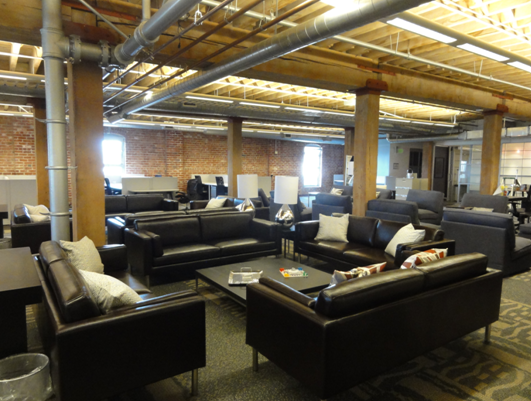
We rent office space on the Westside of Los Angeles and in San Francisco to digital technology companies.  Our tenants include or have included Twitter, Google, DoubleClick, Yammer, Scribd, Applied Semantics, Microsoft, and Eventbrite.  Much has changed from the dot-com days.  Today, the three factors that are important for the design of these spaces are creative environments, densification, and collaboration.  Spaces are open to allow for the ability to scale to densities of up to 10 people per 1000 square feet.  Although the company may start out at 4 people per 1000 square feet, the ability to scale within the space will enable to firm to expand without taking on additional space and without moving.  To allow this densification, the space should have good light, open areas, and a lot of power and outlets.  Higher ceiling volumes with open structural elements help reduce the feeling of being cramped into a tight area.  Although liner table arrangements are the most efficient, undulating plans have also worked and reduce monotony.

Diagram from the dot-com days.

Creatively remodeled office space.

In the dot-com days, designers used circular and angle offices to create visual interest.  Today, these designs reduce the efficiency of the floor plan.  Designers now use the natural beauty of the physical structure, colors, textures, and lighting to create visual interest.

Large, high partition work stations have given way to interconnected non-partitioned tables where groups of designers sit together in close proximity.  Email, texts, and social networking have replaced audio phone use and hence eliminated the need for partitions.  Enclosed spaces are used primarily for conferences, group meetings, and other collaborations.  These enclosed meeting spaces average about 1 per 1000 square feet.

Yammer Collarboration Area at PMI's 410 Townsend in San Francisco.

Collaboration spaces have become more important in offices today.  People are used to collaborating in cafés; now designers are incorporating the “café look” into the office design.  Today workers come from the Starbucks generation where coffee houses are iconic symbols of collaborative settings.

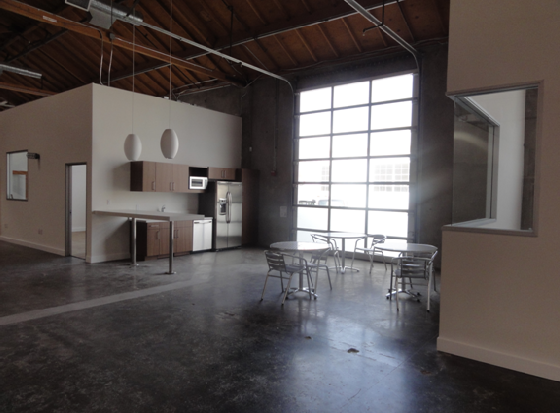
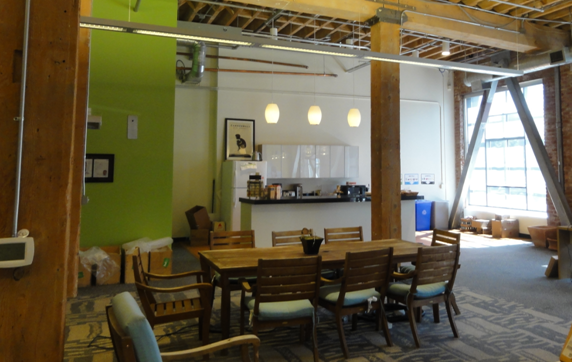
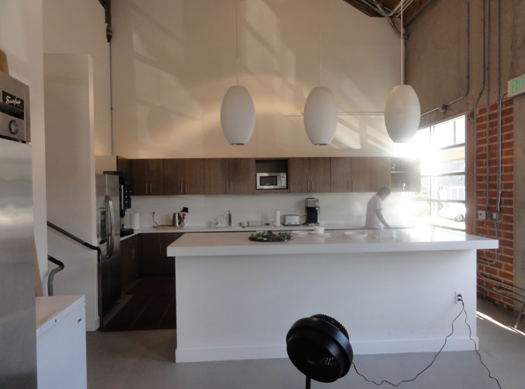
Kitchens have expanded into highly designed café settings in very visible locations.

Kitchen at PMI's 3525 Eastham in Culver City.

Kitchen at TechCrunch at PMI's 410 Townsend in San Francisco.

This is a refreshing contrast to the kitchens of the past, relegated to a hidden enclosed corner with vinyl floors and fluorescent lights.  Several companies, some as small as 40 people, have dining areas that can fit much of the company’s employees.  They also require company lunches several times a month or even a couple times a week.  Other examples of collaborative settings could involve a game room or juice lounge.   Instead of just one kitchen, there may even be multiple areas with sinks, refrigerators, and snacks.  This gives a modern spin to the popular water cooler meeting spot that all offices seem to share.

All in all, there are many designs and combinations that can be created for all the different types of tenants we house.  For PMI, we strive to meet all of our tenant’s requests and see to it that creativity continues to flourish among our properties and tenants.  Scroll down to see more examples of the creative space we have produced for our outstanding tenants!

Kitchen at Mitch Kapor's offices at 543 Howard in San Francisco.
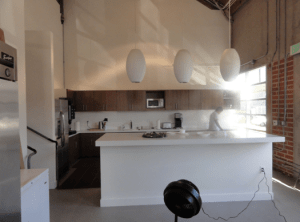
Mahalo's Kitchen at PMI's 3523 Eastham in Culver City.
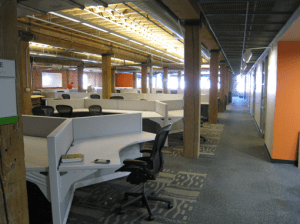
Eventbrite's former space at PMI's 410 Townsend in San Francisco.
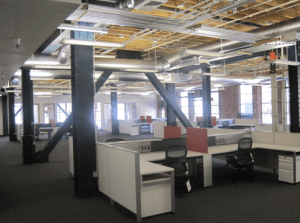
Afar Media at PMI's 394 Pacific in San Francisco.


Tech Start-ups Flock to L.A.’s ‘Silicon Beach’

Tech is quickly spreading profusely over Los Angeles.  Northern California is no longer the only place where up and coming tech, web, and new media companies are calling home.  The L.A. Times recently published an article detailing companies and new tech start-ups who have made chosen “Silicon Beach” over “Silicon Valley.”

Some start-ups are also searching for suites in Los Angeles that are flexible and easy to remodel to fit their needs as a company.  One major tenant broker reported a flurry of requirements for companies that produce video content for the web.  PMI has received interest from a few companies that require building several of these web video studios.  PMI is trying to figure out how to best accommodate these needs by making the restoration of the space less expensive.  The companies who are requesting restoration believe that the renovated studio will have additional value for the next company who will occupy it.  However, in the event that the next company does not prefer the modifications previously made– maybe they are involved with a different type of business– the company will want the web video studio layout removed.  Adding to the complexity of the situation, these companies also have different studio requirements; there isn’t an adequate generic standard these studios can be crafted by.

PMI is working to accomdate all of their tenant’s requests, and are happy to welcome new and creative companies at their properties.  With the creation of Silicon Beach, we expect the creative office space demand to rise even further.

Five Santa Monica Office Buildings Sell for $90 Million

When PMI Properties helped invent the Los Angeles creative office business back in the mid-1990s, there was no institutional investment in creative office.  The institutions thought creative office was a fad and didn’t really understand the business.  Now Lionstone Group owns more than a million square feet of creative office space.  Hudson, Kilroy, Alcion, Divco, and many others are now buyers and developers of creative office spaces.

PMI has it’s share of tech, new media and production companies residing at our creative offices and we are rapidly expanding and accepting more tenants month by month.  To see the variety and scope of our tenants, click here.

The LA Times article here expands more on the creative office space boom.

Past and Present PMI Tenants– Join the Ranks of the Best

Ever since it’s inception, PMI Properties has been home to many up and coming creative companies.  From video games and film to advertising and software designers, we’ve had the pleasure of housing all types of creative companies.   A social networking company exploded into society’s consciousness from our offices. They now have over 300 million users and changed the way we communicate in 140 characters or less online.  They also reinvented the meaning to the word, “tweet.”  That company is none other than Twitter.  Applied Semantics, producer of software applications for the online advertising, domain name, and enterprise information management markets, invented AdSense in a PMI Property office space.  AdSense has since been acquired by Google, and is now responsible for over 25% of their revenue.

It’s been said that our Properties Motivate Innovation.

A few more you may have heard of include Columbia Pictures, Matt Damon and Ben Affleck’s Project Greenlight, HBO Entertainment, Google, Wes Craven, Summit Entertainment, Sony Electronics and Ubisoft.

To gain a larger sense of our scope and variety of amazing tenants, check out our complete list of past and present PMI tenants below.

Entertainment

  • Bruce Lee Enterprises
  • Concrete Pictures
  • Franklin and Waterman (Film)
  • Imperial Entertainment
  • Infinite Monkey Entertainment
  • Nalin (Film)
  • Public Interest Films (Film Production)
  • Sony Pictures
  • Strand Releasing (Movie Distribution)
  • Trimark Films (Film/Merged with Lionsgate)
  • David Koz (Musician)
  • Domo Records (Music Publishing)
  • John Erhlich (Music Editing)
  • Music Choice (Internet Music)
  • Rick Knowles (Music Production)
  • Tonos (Music Website/Carol Bayer Sager)
  • Varese Sarabande (Music Publishing)
  • Vibe (Music Publishing)
  • Fox Entertainment
  • Gurin Company (Television Production)
  • Millionaires Club (Television)
  • Mixed Signals (Interactive Television)
  • Termite Art (Television Production)

Production 

  • Tangerine Entertainment (Commercial Production)
  • Halon Entertainment (Pre Production)
  • Animal Logic (Post Production)
  • At The Post (Post Production)
  • Goodspot (Post Production)
  • Jack Fx (Post Production)
  • King and Country (Post Production)
  • Liquid (Post Production)
  • Moxie Pictures (Post Production)
  • Propeller (Post Production)
  • Radium (Post Production)
  • Rex Edit (Post Production)
  • Safehouse (Post Production)
  • Sol Design (Post Production)
  • Superior Assembly (Post Production)
  • On Line Off Line (Video Production)

Software

  • Applied Semantics
  • Apture (Web Software)
  • Codehost (Software)
  • Coding Technologies (Software)
  • Double Click (Web Advertising Software)
  • Epoch-Paycom (Digital Payment Web Software)
  • Guardian Edge (Web Software)
  • Ingrooves (Web Music Software)
  • Insync (Web Music Software)
  • IOTA (Web Music Software)
  • Jaspersoft (Software)
  • Limelight (Software)
  • Opendns (Software)
  • Outlook
  • Playdom (Software)
  • Radar (Web Software)
  • Retix (Software)
  • Supersig (Web Software)
  • The Brain (Software)
  • Xobni (Web Software)
  • Yammer (Saas Collaborative Software)
  • Yola (Web Software)
  • Zendesk (Web Software)

Advertising

  • Bright Design
  • Bush Communications
  • Click Media (Digital Advertising)
  • DCA
  • Deep Focus
  • Domozog
  • Expert Communications
  • Grange Advertising
  • Ideology
  • McElroy
  • Murphy Obrien
  • Point Blank
  • PR 21
  • Rocket Studios
  • Spelling Communications
  • Woo Advertising

Video Gaming

  • Outspark
  • Playdom
  • Six Degree Games
  • Sony Computer Entertainment
  • Sulake
  • Ubisoft
  • Workshop Entertainment

Digital Marketing & Publishing

  • AZ Razorfish (Digital Marketing)
  • Carbon Five (Digital Marketing)
  • Maholo (Digital Publishing)
  • Scribd (Digital Publishing)
  • Techcrunch (Digital Publishing)
  • Threshold (Digital Marketing)

Web

  • Eventbrite (Web Ticket Sales)
  • Google (First LA Offices/AdSense)
  • Motoreyes (Website)
  • Top Tutor/Idealabs (Education Website)
  • http://www.com (Website)

Miscellaneous

  • Dunket–Shaquille O’Neal (eCommerce)
  • Savings.com (eCommerce)
  • Sony Electronics (Electronic Consumer Hardware)
  • Diamond Multimedia/Rioport (Electronic Hardware)
  • NatureEner (Green Technology)